Prefer Jewish News on Google
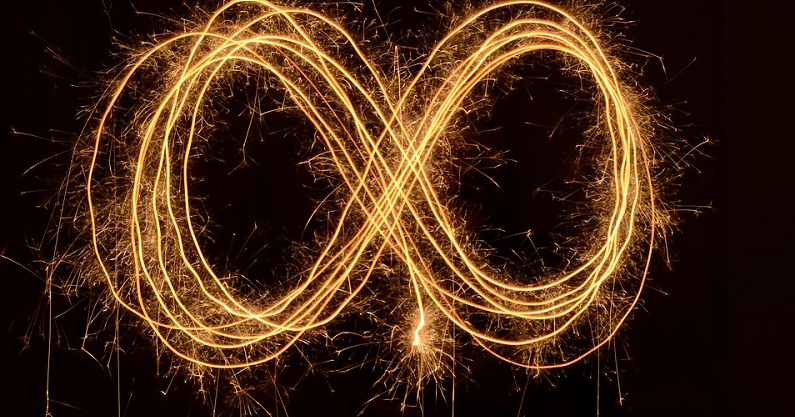
What’s in a number? Infinity
Rabbi Garry Wayland helps figure out why Inifinity is so significant to the Jewish tradition
In a very civil shul kiddush, there is but one biscuit left. Sadie does not want to take the whole last biscuit, so subtly nabs half.
Morris then comes, and, with similar manners, wants to leave a morsel for someone else, so divides the remaining half into two pieces and takes one, and
so on.
While this scenario may not actually be feasible, it raises a paradox: can you keep breaking this biscuit into halves without it actually being depleted?
If you intuitively say yes, you are not alone. Zeno, a Greek mathematician from the 5th century BC formulated this as one of his paradoxes.
Ultimately, the biscuit can get eaten (and, in most shuls, probably will), because an infinite number of infinitesimally small pieces has an actual limit.


Bridging the gap between the infinite and the finite takes on many forms: in maths, it is the set of tools known as differentiation and integration and is used by thinkers such as Kant, Cantor and Russell to deal with philosophical problems.
The 16th century Kabbalist Arizal put forward the idea of tzimtzum: the “contraction” process used by an infinite God to create and interact with a finite world.
Kabbalists refer to God as Ain Sof, the One without limits. In contrast, our finite minds can only comprehend what God is not.
He is not limited, not corporeal, not like anything else. As such, we are unable to relate to His true essence.
Connecting to God is the task of a lifetime; we can variously relate to God as a king, father, parent, master, Lord, source, the One without limits, and so on.
Infinity also affects the paradoxes in our own lives. If we look at the infinite number of pieces that come together to make the tapestries of our consciousness, our lives, our existences, we can perhaps learn a bit more about the infinite One, who is infinitely involved in our lives.
Rabbi Garry Wayland is the former assistant rabbi at Woodside Park United Synagogue

Keep community journalism free.
Jewish News is free for everyone. No paywall. No barriers. Just trusted journalism for anyone who wants to stay connected to Jewish life in Britain.
If you value that, please support us.
From as little as £5 a month, you can help keep our journalism free and accessible to all.
Every day, we report on the issues that matter to our community. We celebrate achievements, support charities, challenge antisemitism and ensure Jewish voices are heard more widely.
From as little as £5 a month, you can help us continue to:
- Report on the stories shaping Jewish life in the UK and beyond
- Bring our community together through shared stories, events and campaigns
- Celebrate the people, culture and moments that define our community
- Support organisations doing vital work across Jewish Britain
You can make a one-off donation or become a regular supporter. Every contribution helps keep our journalism free, independent and accessible to all.
If everyone who values Jewish News gave a small amount, it would make a real difference to our future.