Prefer Jewish News on Google
Will Timothée Chalamet get Oscar for portrayal of ping pong player Marty Reisman?
Marty Supreme is the true story of the 'bad boy of ping pong' who grew up on the Lower East Side
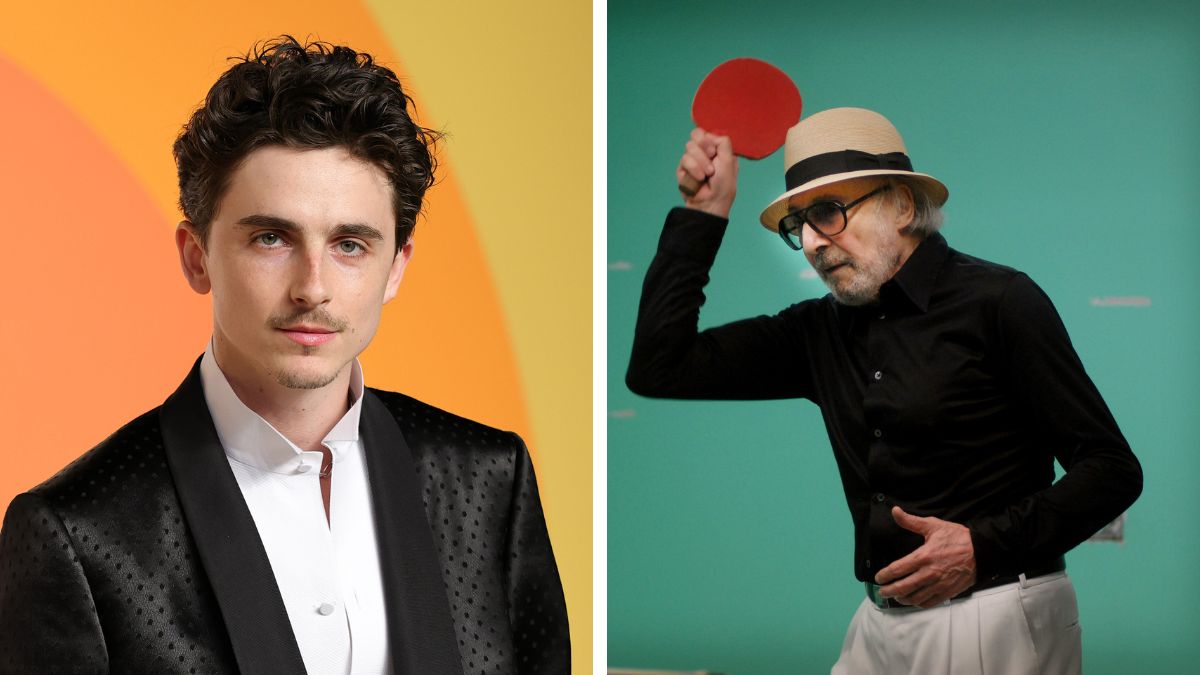
It’s the winter holiday season and half-Jewish heartthrob Timothée Chalamet, following his 2024 portrayal of legendary folk musician Bob Dylan in A Complete Unknown, is once again playing a movie role based on a Jewish celebrity.
This time, Chalamet, who is named for his Jewish grandfather, is swapping a guitar for a ping pong paddle for his role in the buzzy Marty Supreme, which is out in cinemas on 25 December. The Josh Safdie-directed film, nominated for three Golden Globes and likely to earn Best Picture and Best Actor Oscar noms, is loosely based on The Money Player, the autobiography of the eccentric, real-life Jewish table tennis champion Marty “The Needle” Reisman — so nicknamed for his tall, slim build and his quick wit.
The movie is fully stacked with a Jewish cast, including Fran Drescher as Mauser’s mother, Gwyneth Paltrow as Mauser’s love interest, and featuring Odessa A’zion, Sandra Bernhard and designer Isaac Mizrahi. “Well, it’s a story about Jewish people so I needed Jewish actors,” Safdie, who is Jewish, said at a recent press conference for the film.
Though the film isn’t completely faithful to Reisman’s real-life story — the movie’s titular character has been changed to Marty Mauser — the actual and the fictional Marty both grew up Jewish in New York City, and both began seeking athletic greatness at the ping pong table in the 1940s.
Reisman (pronounced REESE-man) was born in February 1930 in New York to Russian Jewish immigrants Sarah “Sally” Nemorosky and Morris Reisman. He grew up on the Lower East Side, where he attended Hebrew school and his family ate boiled beef and potatoes for Shabbat dinners.


Reisman had an older brother, David; his father was a cab driver with a large fleet of taxis and a serious gambling habit. In 1977, Reisman told Sports Illustrated: “I saw my dad lose six taxis during one session of poker.”
Perhaps it’s no surprise, then, that in addition to his table tennis skills and his preference for the old-fashioned hard bat paddle, Reisman was also known for his big bets on his own ping pong games. At just 15, he mistakenly handed a $500 wad of cash to an official from the United States Table Tennis Association instead of his bookie, and was escorted by police out of the tournament.
Reisman first discovered table tennis following a “nervous breakdown” at the age of nine, and realized that playing the game helped him feel better. Much of his early playing was done at the Educational Alliance on East Broadway, one of New York City’s first settlement houses, which was established in 1889 “to offer educational, social, and cultural services to Jewish immigrants arriving to the Lower East Side.” By the time he was 13, Reisman was already New York City’s junior champion.
As a young man, Reisman continued playing and earning titles, medalling in five world championships from 1948 to 1952. From 1949 to 1951, Reisman and his partner Doug Cartland became the comedic warmup act for the Harlem Globetrotters at Madison Square Garden, playing Mary Had a Little Lamb with frying pans, and hitting balls across the net using just the soles of their sneakers.
According to The Sun, “the British press were so enamoured by him [Reisman] that they called him the ‘Danny Kaye of table tennis’” — so named for the Jewish actor who was famous for his physical comedy.
Over the years, he toured the world, gambled on his own matches and gained a reputation for spending, becoming known for his brightly coloured outfits topped with Borsalino fedoras and Panama hats. Reisman’s signature trick — apart from a habit of measuring table tennis nets with a $100 bill — was to split in half an upright cigarette at one end of the table with the sheer force of the ball he hit with his paddle.
In 1957, after performing poorly against a Japanese opponent who played with the new, spongier bats, Reisman allegedly returned from his Asia tour with an armful of Rolexes under his shirt sleeve.
As the world of ping pong evolved, Reisman struggled to adapt to a “normal” life, as he wrote in his book. Reisman couldn’t hold down a regular job — something he wanted in order to impress his soon-to-be wife, Geri Falk. Reisman was fired from the only non-ping pong gig he ever tried: working in the shoe department at the Jewish-owned New York City department store B. Altman and Company (which just so happens be where the fictitious Jewish comedian Midge Maisel worked in the Amazon Prime series The Marvelous Mrs. Maisel).
And so, in 1958, he purchased an indoor tennis club on the Upper West Side, Riverside Table Tennis Courts. The spot was frequented by celebrities, many of them Jewish, like chess player Bobby Fischer and actors Dustin Hoffman, Walter Matthau and Zero Mostel. Actor Matthew Broderick played there as a kid, which he recalled in a 2008 episode of The Late Show with David Letterman. Reisman opened two more locations in Midtown.
In 1982, “the bad boy of ping pong,” as Reisman was known, married his second wife, Yoshiko Koshino, in Manhattan. He has one daughter, Debbie, from his marriage to Falk in 1958, whom he met at Riverside Table Tennis Courts.
In 1997, at 67 years old, Reisman became the oldest person to win an open national competition in a racquet sport.
Reisman died in Manhattan in 2012 at the age of 82 from lung and heart complications and is buried at a Jewish cemetery on Staten Island.

Keep community journalism free.
Jewish News is free for everyone. No paywall. No barriers. Just trusted journalism for anyone who wants to stay connected to Jewish life in Britain.
If you value that, please support us.
From as little as £5 a month, you can help keep our journalism free and accessible to all.
Every day, we report on the issues that matter to our community. We celebrate achievements, support charities, challenge antisemitism and ensure Jewish voices are heard more widely.
From as little as £5 a month, you can help us continue to:
- Report on the stories shaping Jewish life in the UK and beyond
- Bring our community together through shared stories, events and campaigns
- Celebrate the people, culture and moments that define our community
- Support organisations doing vital work across Jewish Britain
You can make a one-off donation or become a regular supporter. Every contribution helps keep our journalism free, independent and accessible to all.
If everyone who values Jewish News gave a small amount, it would make a real difference to our future.