Prefer Jewish News on Google
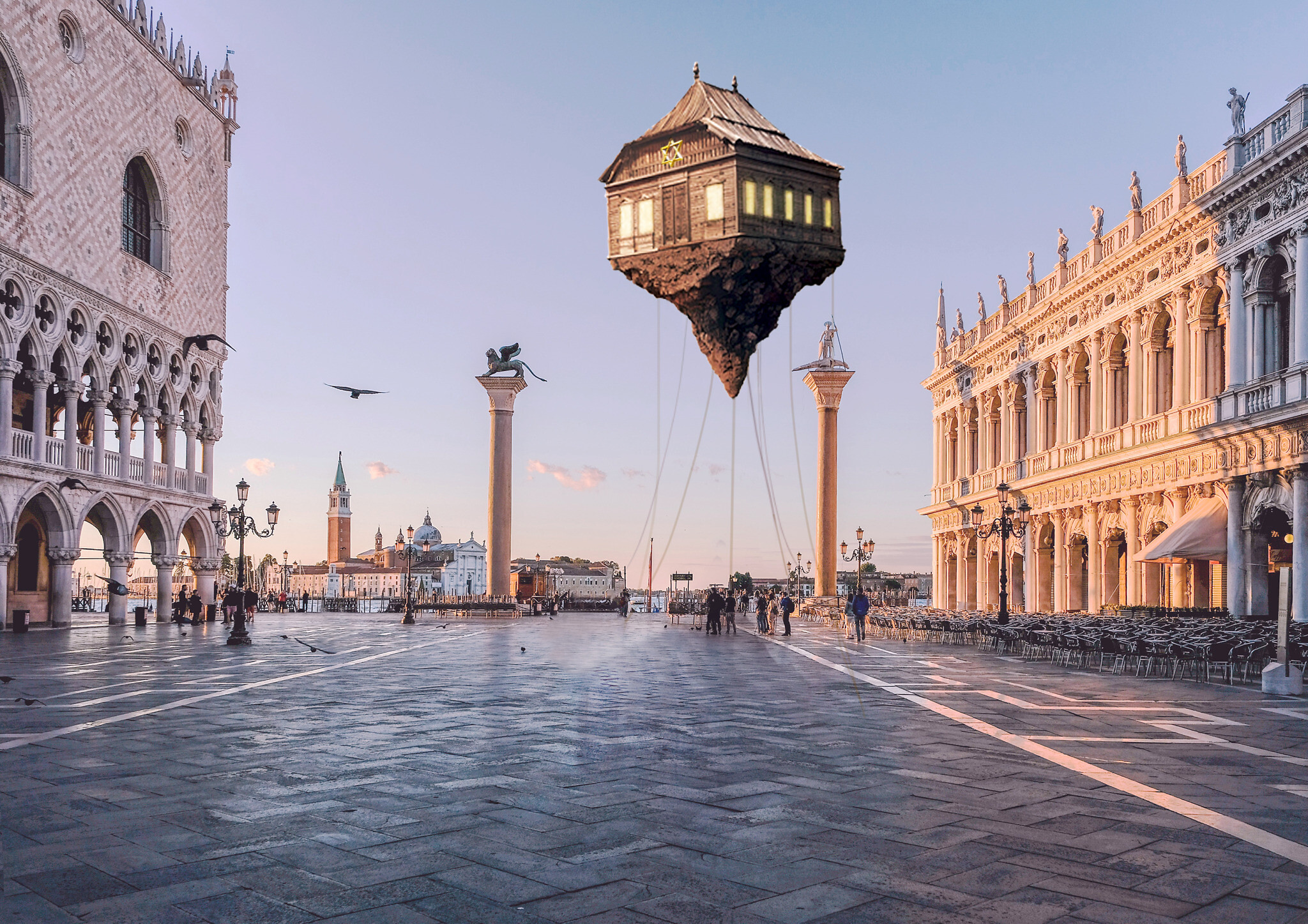
Artist Anna Kamyshan’s ‘Natabale’ sculpture is modelled on the shtetls of Eastern Europe
In a win for Jewish visibility, a 12-metre-tall inflatable sculpture of a synagogue has set sail above the Venice Lagoon.
Five hundred years ago synagogues were banned from being seen in Venice. Jews had to practice covertly, concealing their houses of worship inside existing, unassuming buildings, so to see one rising out and proud above the city is a matter of deep and emotive pride. However, for artist Anna Kamyshan the fact her synagogue must float for lack of any permanent land to stand on is the most important aspect of her installation, a reminder of the centuries when Jews had no nation of their own in which to build their synagogues.
“Of course artists want their work to be visible,” she says, “but my main intention was for it not to be rooted, because as Jews we are always moving, being everywhere but nowhere at the same time.”
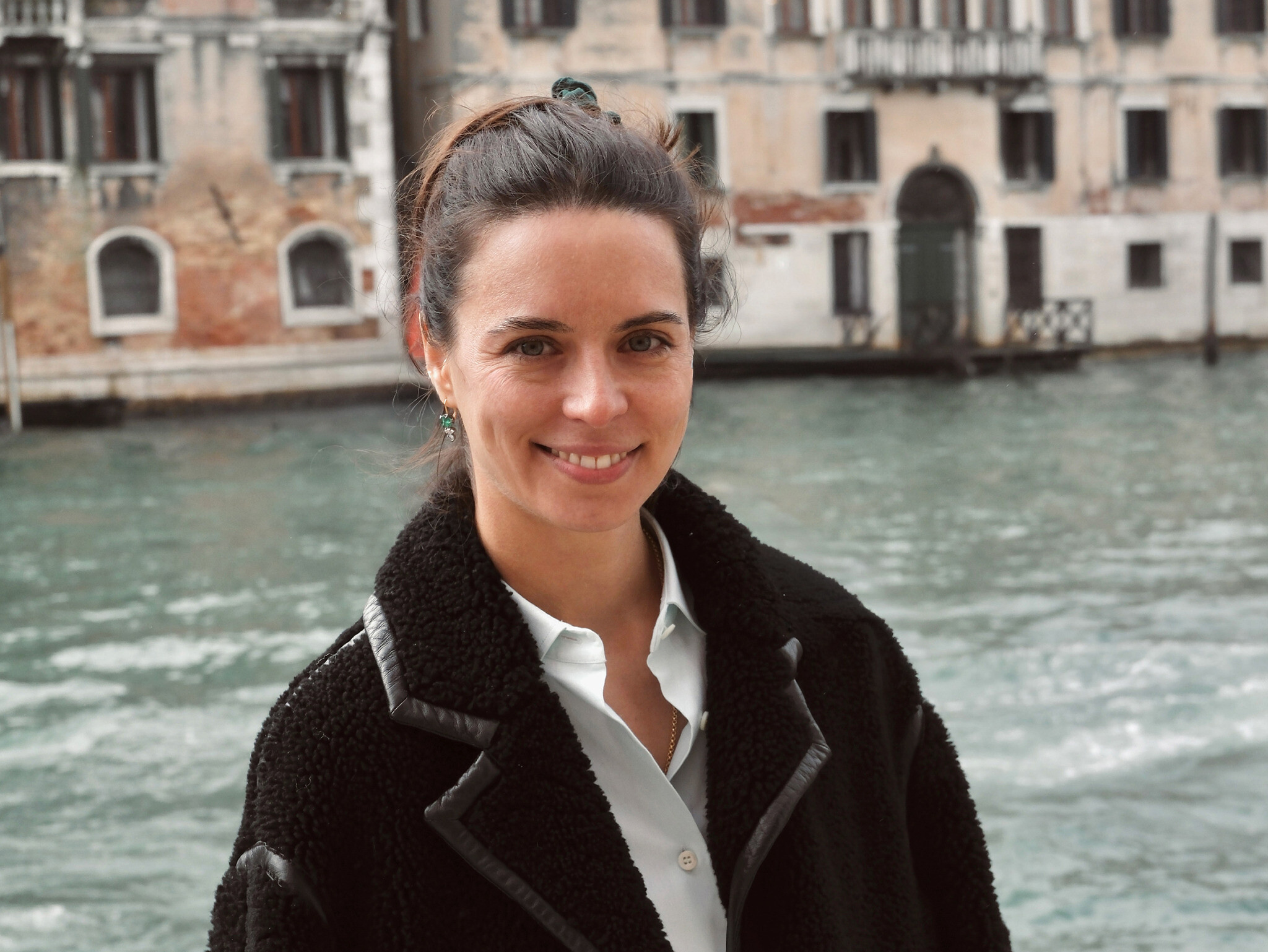
Nabatele, as the shtetl-style shul, modelled on the hundreds of wooden synagogues which once stood across the whole of rural eastern Europe, is also a reminder to its creator of a long search for her own sense of belonging. Growing up Russian-speaking in Ukraine, working in Moscow and Graz as well as Kyiv, she came to London when war broke out but is also partly based in New York. And that’s just the geography of her life; the most profound impact on her identity was learning at the age of 11 that she had Jewish heritage.
“It was massive for me at the time, but I really started to engage with Judaism when I started working on the vision for a Holocaust memorial centre for Babyn Yar ravine,” says the London-based artist and architect, whose own Jewish family were murdered by the Nazis in another such ravine, Drobitsky Yar outside Kharkiv.
“The event was so traumatic for my grandfather, who escaped, that he never talked about it until my father came back from a trip to Israel raving about the country,” says Kamyshan, who gets her surname from the former Dmitri Zilberberg, who changed it to an amorphous, non-Jewish-sounding name to save his life.
But her father’s exuberance about Israel, which he had visited only by chance for work – “He loved it so much he wanted our whole family to move there,” says Kamyshan – broke Dmitri’s decades of silence about his past. “Only then did my grandfather share the stories of his past and tell us we were Jewish.”
Although she embraced this news – “it became a massive part of my self-identity” – after the longed-for Aliyah failed to happen, causing massive disappointment to her father, Anna put it to one side for a few years as she entered art school and embarked on an architecture degree: “My profession took me over”. But the engagement with her Jewish identity resurfaced when she started work on Babyn Yar, where she served as director of conceptual development and research for the memorial for the 33,000 Jews murdered there in 1941.
Nabatele – its name is a diminution of the Yiddish word for ‘call to action’ – started life last year as a video for the Yiddishland Pavilion, which has created a forum for Jewish art from all nations at the Venice Biennale. Kamyshan’s Castle of Yiddishland shows a lost wooden shul flying from above a Venice canal across the skylines of Chicago, London, Warsaw, New York, Berlin, Jerusalem, Odessa, Antwerp, Vilnius and LA – all but Jerusalem diaspora cities containing their own, often precarious Yiddishlands – before spinning back to the heart of Venice in San Marco.
To bring the concept to fruition as a physical object – “this was a prequel – at that time I didn’t have the engineering solution or the money” – took every skill in Anna’s multidisciplinary toolbox. “I can do many things, from visualising a project to its detailed execution. I talk to engineers in their own language and serve as my own production manager. I raise the money and work with independent companies instead of building a team of my own.”
There are, of course, the technicians who will be present on site for the duration of the installation – “we have to babysit this object 24/7“ – after she has spent several days in Venice setting it afloat. Security in a highly visible position – where the Arsenale, one of the two chief Biennale sites, meets the lagoon – is a must to keep vandals at bay and make sure the helium-filled object stays afloat.
The original plans were for the most prominent site in Venice of all, the water facing San Marco: “but one of the city authorities which had to give approval was afraid of the public reaction to the subject.” The change of site delayed the opening by two months and increased the cost of the project exponentially, involving moving two cranes and paying rent for the land above which the model will now be set afloat.
While its official expiration date in Venice, where there will be an event with the modern community enjoying a resurgence of Jewish life, is mid-September, Anna hopes the installation will stay afloat for at least a month longer, and is in discussion with not only the Montreal Jewish Museum, who organised the Venice event, but others overseas who are keen to give the artwork new life in their own corner of the diaspora. “For this synagogue, all they need is space, not land.”

Keep community journalism free.
Jewish News is free for everyone. No paywall. No barriers. Just trusted journalism for anyone who wants to stay connected to Jewish life in Britain.
If you value that, please support us.
From as little as £5 a month, you can help keep our journalism free and accessible to all.
Every day, we report on the issues that matter to our community. We celebrate achievements, support charities, challenge antisemitism and ensure Jewish voices are heard more widely.
From as little as £5 a month, you can help us continue to:
- Report on the stories shaping Jewish life in the UK and beyond
- Bring our community together through shared stories, events and campaigns
- Celebrate the people, culture and moments that define our community
- Support organisations doing vital work across Jewish Britain
You can make a one-off donation or become a regular supporter. Every contribution helps keep our journalism free, independent and accessible to all.
If everyone who values Jewish News gave a small amount, it would make a real difference to our future.