Prefer Jewish News on Google
ChatGPT acquitted of “crimes” in mock trial
Rabbis and educators at LSJS debate value of Artificial Intelligence in Jewish learning
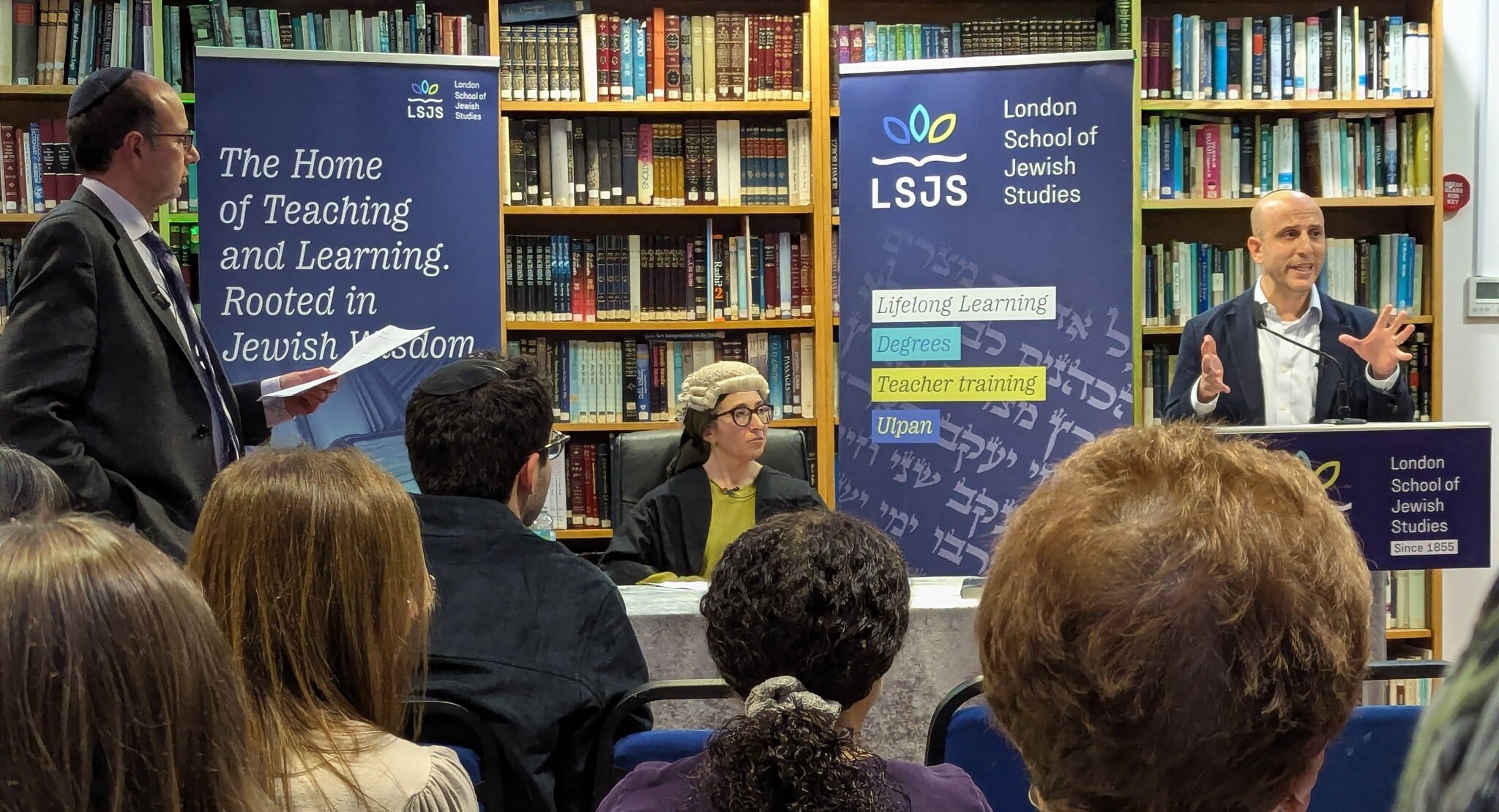
By a margin of 57 votes to 47, the Artificial Intelligence (AI) program ChatGPT has been “acquitted” of a raft of crimes against human beings and education in a lively — and at times hilarious — debate held by the London School of Jewish Studies.
A packed crowd and a global online audience of more than 350 people watched with fascination, as LSJS’s immediate past chief executive, Joanne Greenaway, put on a black robe and judge’s wig as she presided over the mock court proceedings.
The charges against ChatGPT included fabrication, often of Torah sources, encouraging learning with AI at the expense of collaborative study, and prioritising easy answers over deep understanding. The central question was whether AI was transforming Jewish learning, or threatening the tradition itself.
Leading the prosecution was Rabbi Dr Raphael Zarum, Dean of LSJS and holder of the Rabbi Sacks chair in modern Jewish thought. In his opening remarks, he accused AI of being “the greatest temptation ever invented”, and a “pernicious threat to good Jewish education” which “needed to be restrained.” He said ChatGPT was “programmed to please rather than tell the truth”, and accused it of “schmoozing” the user in order to deliver swift and easy answers.
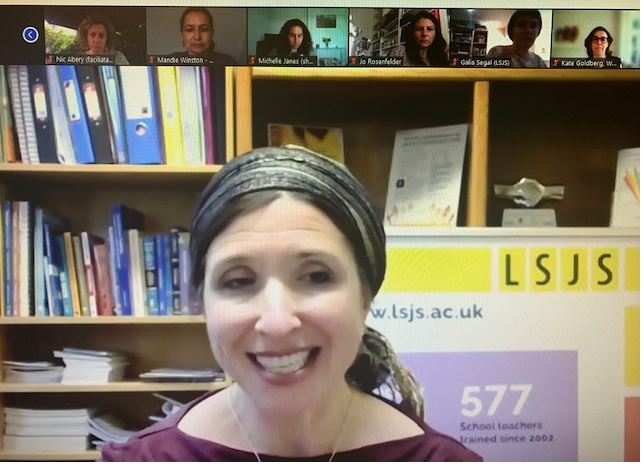
LSJS chief executive Joanne Greenaway
But Rabbi Dr Harris Bor, appearing for the defence, had a very different take. He is a barrister, a lecturer at LSJS, and — crucially — the author of Staying Human, A Theology for the Age of Artificial Intelligence. He maintained that AI would make people better in the disciplines they chose to ask about — and noted that since AI was only brought into use in 2022, it should be treated like any four-year-old, with the various current “glitches” being dealt with as it “grew up”.



Both prosecution and defence were able to call expert witnesses: Rabbi Dr Glenn Bezalel for the prosecution and Dr Helena Miller for the defence. Rabbi Bezalel is deputy head at the City of London School, and obtained his doctorate for a study of conspiracy theories among young people. He said that his school had banned the use of mobile phones entirely — even before his arrival at the school — and reminded “the jury” that “teenagers are hardwired to make wrong decisions”, supporting his belief that using AI was detrimental to students’ education.
But Dr Miller, director of post-graduate degrees and senior research fellow at LSJS, believed that AI had useful functions to perform and was valuable in assisting education, provided the teacher was in control of how it was used. “We have to be in charge of AI, not the other way around”, she maintained.
By far the most startling part of the court case was when Rabbi Dr Bor called one more witness — ChatGPT itself. Cross-examining, Rabbi Zarum asked the program on screen a series of “human” questions to which it had no answer, repeatedly telling the court that it did not have an identity and was merely a “language model”. Thus it was unable to answer questions such as “what time is mincha at Munk’s in Golders Green?”
Despite this “gotcha” moment, Rabbi Zarum was unable to convince the “jury” of the rightfulness of his case. He told JN later that the very “reasonableness” with which ChatGPT had responded, formed part of its danger. “It’s trying to please the questioner all the time”, he said.

Keep community journalism free.
Jewish News is free for everyone. No paywall. No barriers. Just trusted journalism for anyone who wants to stay connected to Jewish life in Britain.
If you value that, please support us.
From as little as £5 a month, you can help keep our journalism free and accessible to all.
Every day, we report on the issues that matter to our community. We celebrate achievements, support charities, challenge antisemitism and ensure Jewish voices are heard more widely.
From as little as £5 a month, you can help us continue to:
- Report on the stories shaping Jewish life in the UK and beyond
- Bring our community together through shared stories, events and campaigns
- Celebrate the people, culture and moments that define our community
- Support organisations doing vital work across Jewish Britain
You can make a one-off donation or become a regular supporter. Every contribution helps keep our journalism free, independent and accessible to all.
If everyone who values Jewish News gave a small amount, it would make a real difference to our future.