Prefer Jewish News on Google

Grappling with Jewish identity in a more hostile world
As many of us face questions brought about by the sharp resurgence of antisemitism, different Jews are arriving at different answers
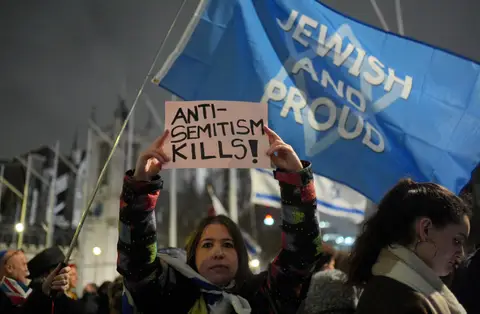
The Jewish Question is back. Unfortunately, you don’t have to delve too far into the fever swamps of X or YouTube to find online influencers, cod philosophers and faux-geopoliticians openly debating the insidious nature of Jewish influence upon the world and what to do about it.
The most famous among them include the likes of Nick Fuentes and Candace Owens, but there are many others out there also peddling old antisemitism on new platforms. The brutal Gaza war, which unfortunately coincided with and then amplified a dark algorithmic turn online, has revived some latent maladies in the body politic, particularly in America, which we all live downstream from.
A thoughtful new essay by David Azarrad in Compact magazine details the return of the “JQ” – the Jewish Question. Azerrad explains that JQ proponents on the American right believe that “Jews have promoted radical leftism as a survival strategy to undermine host societies”. They believe that from multiculturalism to psychoanalysis, feminism, civil rights and sexual liberation, Jewish thinkers and ideologues have corrupted the body politic with their perverted ideas. They are, such people put forward, the elemental source of whatever’s gone wrong. (Extremists on the left take a different path, through settler-colonialism and white supremacy, but end up in broadly the same place.)
This is not mainstream thought, but it is real and discussed by millions. And so with the revival of their Jewish question comes the return of ours: how to be a Jew in an increasingly hostile world? Should one identify proudly or create distance? Stay with the tribe or melt away? Stick with Israel or disavow it?

Of course, these questions have always been with us, they are inherent to Jewishness. But for most of my life at least, they have been fairly marginal. Growing up in the di tsayt goldeneh of the nineties and noughts, I didn’t expend too much energy on the existential nature of my Judaism. It was a challenge, of course, but not a particularly heavy or painful burden.


But now it feels as though we are in a different era, experiencing a reversion, perhaps, to a more familiar Jewish mode of being. Over the New Year’s break, I travelled to Venice for the first time, soliciting various recommendations for where best to eat, drink and gawp at elaborate frescoes. Naturally people suggested going to see the Jewish ghetto, established in 1516 as the first of its kind anywhere in the world, the origin for the very word and concept: ghetto.
It feels as though we are in a different era, experiencing a reversion, perhaps, to a more familiar Jewish mode of being
I went of course, twice in fact (truly my father’s son), but I was surprised by how miserable it made me. The way you have to stoop into a narrow, humiliating little passageway to enter the tiny island. The group of bored armed policemen lolling in the piazza. The harrowing bronzes on the walls depicting the aktions (or is that azioni) that led to 289 Jews being deported from Venice between 1943 and 1945, with just seven returning. The buildings piled seven storeys high to pack in as many residents as possible. The physical claustrophobia of the space but also its feeling of emotional siege, the sense that to be born a Jew then was to be born on a small constricted island, cut off from normality across the canal, crossing back and forth only with difficulty, paying the guards and hoping they keep you safe.
I think five years ago I would have found the Venetian ghetto distressing in a distant sort of way. This time it hit me much harder. Do other tribes have tourist attractions like this? Some 300 miles south in the Italian capital, there’s the “In the Ghetto” restaurant, where one can sample the best of Jewish-Romanesque food.
I don’t want to be histrionic. There are no Jewish ghettos, requirements for yellow stars, or curfews in my world today. Nor, I will add with emphasis, am I stuck in a miserable tent in Gaza with no plumbing and Hamas for company. We don’t know where this current wave of antisemitism is headed and much is dependent on how events unfold in the Middle East. But that sense of creeping, claustrophobic hostility certainly feels more accessible than it once did. The old Jewish questions are louder than they once were.
Five years ago, I wrote a column about the 19th century German poet, Heinrich Heine, who wrestled with his own Jewish questions. Despite his greatness, Heine struggled to find acceptance in an increasingly antisemitic Prussia. He lost friends, was shut out from prestigious academic jobs and prosecuted for apparent literary transgressions.
“Our descendants,” Heine once wrote of being a Jew in his world, “will shudder when they come to read what a ghostly life we led, how our humanity was cleft in two.” Heine answered his own Jewish questions by converting to Protestantism, but it didn’t help. Christian Germany never accepted him and he hated himself for doing it.
My conclusion was a note of thanksgiving, that the liberation Heine sought was mine by right. And it still is. I don’t face the immense tectonic stress of being shut off and rejected by a nation I love, my home. But the questions are louder than they once were.
What do they think of me? How should I relate to my Judaism in public? Should I say the word Jewish in the back of a taxi or on a bus? Or should I whisper it instead? Or change the subject? Are people going to ask me about Israel? If so, what will I say? Or, worse, will they not ask me about Israel but impose a kind of silent distance, which I will fill with fretful speculation?
All these small questions accumulate to pose bigger ones: am I in or out of this mess? Do I want to show the critics I’m a good Jew, disgusted by my barbaric cousins in the Levant? Or should I hold the line and let them draw their own conclusions? I could even double down and become more hawkish, as some have. Or I could stay silent, avoid the hard bits and hope for the best.
These JQs rattle around our heads daily and everywhere around us, we see our fellow Jews coming up with different answers, positioning themselves differently under mounting psychic stress, changing in front of our eyes. Becoming angrier, or more anxious, or more withdrawn.
In truth there are no easy answers to these questions and there never have been and there never will be. There is only the long hard slog of trying to maintain your inner sense of decency and navigating the world and its furies accordingly.
But there is an overarching choice of sorts. In or out. In the Venetian ghetto, I stopped at the famous David’s shop and bought a Murano glass mezuzah for my new home, which now slouches brightly across the doorpost. So I guess that’s my choice made.
• Josh Glancy is associate editor of The Sunday Times. You can read more of his Jewish News columns HERE

Keep community journalism free.
Jewish News is free for everyone. No paywall. No barriers. Just trusted journalism for anyone who wants to stay connected to Jewish life in Britain.
If you value that, please support us.
From as little as £5 a month, you can help keep our journalism free and accessible to all.
Every day, we report on the issues that matter to our community. We celebrate achievements, support charities, challenge antisemitism and ensure Jewish voices are heard more widely.
From as little as £5 a month, you can help us continue to:
- Report on the stories shaping Jewish life in the UK and beyond
- Bring our community together through shared stories, events and campaigns
- Celebrate the people, culture and moments that define our community
- Support organisations doing vital work across Jewish Britain
You can make a one-off donation or become a regular supporter. Every contribution helps keep our journalism free, independent and accessible to all.
If everyone who values Jewish News gave a small amount, it would make a real difference to our future.