Prefer Jewish News on Google
Holocaust-era songs composed in Nazi ghettos published for first time in English
Translated from Yiddish, the historic collection documents experiences of Jews attempting to survive Nazi persecution
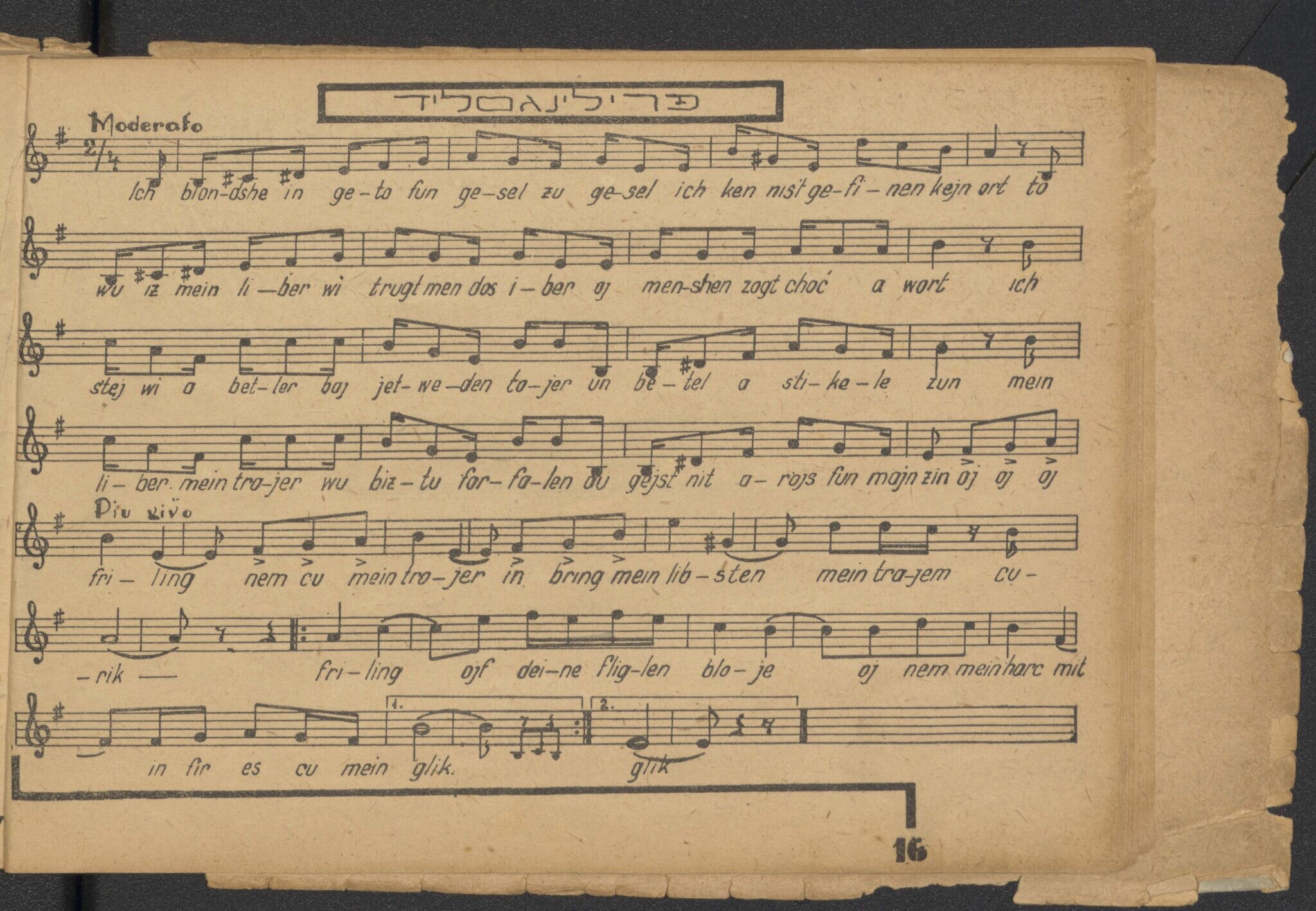
A collection of songs composed and sung in the Nazi camps and ghettos and collected in the immediate aftermath of the devastation of the Holocaust is now being republished by a UK university, which described it as “a remarkable historical document.”
Manchester University Press is publishing a new version of ‘Mima’amakim’ (Out of the depths), which was originally compiled shortly after the Second World War. The collection was begun in June 1945 when a team of researchers, while documenting the experiences of Jewish refugees, began to collect songs.

The resulting book was published in a short run of 500 copies, which were subsequently all but forgotten. It was only through the discovery of one of the original copies in 2013 – thought to be one of only a handful to survive – that the collection returned to wider public consciousness.
The new edition, translated into English from the original Yiddish, is the project of two Australia-based academics: Joseph Toltz, a Jewish music researcher and administrator at the University of Sydney, and Anna Boucher, an Associate Professor of Government and International Relations at the University of Sydney.

As described by the publishers, the new printing contains the songs’ melodies and lyrics, the latter in a new translation by Toltz, as well as short biographies of the composers, drawn from painstaking original research. Introductory essays also provide historical and musicological background. The original editor of Mima’akim, Yehuda Eismann, described the work as a ‘memorial stone for Polish Jewry’.


Manchester University Press told Jewish News the songbook is “a remarkable historical document in its own right, but the work that the authors have done to trace the songwriters and their families and to tell their stories is exemplary. We hope a new generation of readers and music lovers will be moved to engage with these stories and to give life to these songs once more.”
Co-author Anna Boucher said: “In the immediate aftermath of the Holocaust, still in post-traumatic shock, Jews began to collect information about their experiences. This songbook reveals strong cultural, political and legal engagement with the enormity of the Holocaust, from Jewish refugees in transit. In it they convey their sorrow and seek healing through these cultural expressions”.
Joseph Toltz added: “It is amazing to think that a tiny songbook, printed on poor quality paper, could not only survive transit from Bucharest back to Poland and then to Sydney, Australia, but that it could also provide so much information about Jewish life and suffering during the Holocaust. Acting as an aide memoire, the songs depict a vast array of personal experiences, demonstrating the power of musical activity to maintain dignity, provide agency, and convey knowledge of survival against all odds.”

Keep community journalism free.
Jewish News is free for everyone. No paywall. No barriers. Just trusted journalism for anyone who wants to stay connected to Jewish life in Britain.
If you value that, please support us.
From as little as £5 a month, you can help keep our journalism free and accessible to all.
Every day, we report on the issues that matter to our community. We celebrate achievements, support charities, challenge antisemitism and ensure Jewish voices are heard more widely.
From as little as £5 a month, you can help us continue to:
- Report on the stories shaping Jewish life in the UK and beyond
- Bring our community together through shared stories, events and campaigns
- Celebrate the people, culture and moments that define our community
- Support organisations doing vital work across Jewish Britain
You can make a one-off donation or become a regular supporter. Every contribution helps keep our journalism free, independent and accessible to all.
If everyone who values Jewish News gave a small amount, it would make a real difference to our future.