Prefer Jewish News on Google

House of Lords passes Motion of Regret relating to government sanctions regime, citing Israel
Lord Leigh: "these regulations...seem to many to be there to satisfy local domestic political objectives of the foreign secretary and his government"
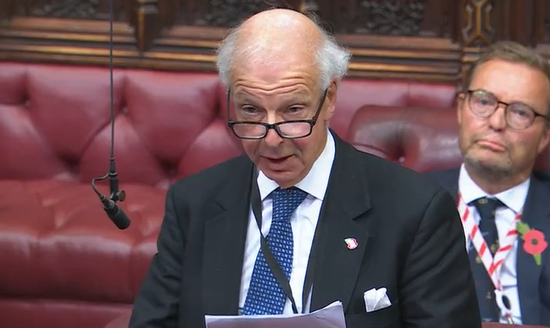
The House of Lords has narrowly voted to pass a motion of regret relating to the government’s sanctions policy – the first such vote since Andy Burnham became Prime Minister – with a wide variety of Peers expressing concerns that the new powers appeared to be singularly aimed at Israel.
Led by Lord Leigh of Hurley, who proposed the motion of regret, a cross-party group of Peers identified a wide variety of problems linked to the Foreign Secretary’s recent announcement of sanctions on the West Bank, which the government has yet to provide any answers to.
Opening the debate on behalf of the government, Lord Wood of Anfield, Parliamentary Under-Secretary of State for Europe, Eastern Europe, International Security and Growth, described sanctions as “a powerful lever we have to advance our foreign policy goals in the face of action that breaks the law and is unacceptable” describing how when such sanctions are imposed, “we do it to send a clear message far beyond those we target, of the values that the UK will stand up for.” He described the “Global Human Rights and International Humanitarian Law Sanctions Regime” as being “particularly vital for this”, saying that “the expanded regime addresses a broader range of human rights abuses and violations, by adding the right to security of liberty and person, and also gives the government the power to respond with sanctions where aid has been deliberately prevented from reaching civilian populations.”
Responding as the Peer who proposed the motion of regret, Lord Leigh said that “Sanctions, precisely targeted and founded on clear evidence, are a legitimate instrument of British foreign policy, and they have my support. But these regulations do not meet that test. They seem to many to be there to satisfy local domestic political objectives of the foreign secretary and his government.
“This is a major change in British foreign policy, made without consultation, made without an impact assessment and without a vote in either house, Parliament is being asked to approve powers already in use. That is not scrutiny; it is ratification.”


Lord Leigh noted that the Foreign Secretary’s statements in the House of Commons made it clear that Israel and the West Bank were the primary targets of the updated sanctions regime.
Contrary to promises made by the government about the regulations being targeted, the Conservative Peer noted that they were in fact wide ranging and could apply to someone even associated with someone involved, saying such sanctions were “not a scalpel; that’s a net. And the government know it.”
He also noted that the government had provided no answers to a wide variety of questions; including the case of Israeli banks, which are mandated by Israeli law to provide services in the West Bank, the tens of thousands of Palestinians currently employed in the West Bank by Israeli firms, and what would happen to a Jewish person purchasing property in the Jewish Quarter of the Old City of Jerusalem, beyond the Green Line.
Lord Leigh also asked whether the government would “refrain from designations while Israel forms a new government at this crucial time”, a theme picked up on by Baroness Ludford, Vice Chair of Liberal Democrat Friends of Israel.
“The Foreign Secretary said in the House on September 8 that our argument is not with the people of Israel; our argument is with the conduct of its government”, Baroness Ludford asked.
“So, should the UK government not prioritise getting a change in the conduct of a new Israeli government away from the destructive policies of the Netanyahu government?”
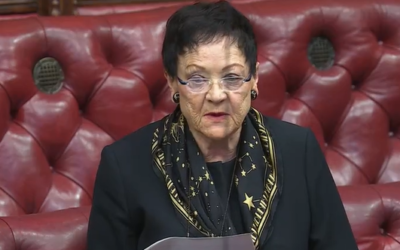
Lord Pickles, Chair of Conservative Friends of Israel said that “if these regulations are truly targeted, those affected should be able to understand where the boundary lies. Yet the government have failed to provide that clarity. Faced with serious penalties, many will simply err on the side of caution.
“Can the government state clearly when buying a home or making a charitable donation in East Jerusalem, including the Western Wall, what becomes grounds for designation. What legal test distinguishes a lawful transaction from sanctionable support? Will the test be published? Trustees, donors, charities should not have to guess whether lawful activity crosses the invisible line.”
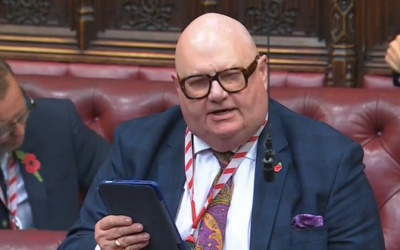
As a former Director of Conservative Friends of Israel, Lord Polak noted that “over many years, I have taken more than 150 delegations of parliamentarians to Israel and the region. I have seen what Britain can achieve when we are trusted, and when we are in the room, and I have sadly watched this government give it all away.”
He cited Conservative Leader Kemi Badenoch, who on Tuesday had said, “in relation to our national security and defence, ‘this is not a student union; it is the running of our country’. My lords, this sanctions policy is another example of student politics at its worst. During this debate, by my calculation, there have been about 40 or so legitimate questions posed to the minister. We did not have an opportunity before the SI [Statutory Instrument] was laid, so I struggle to understand how such a flawed policy can be rushed through with no parliamentary scrutiny and done on purely domestic political considerations.”
Baroness Altmann warned that the government’s sanctions announcement “rewards those who are opposed to a two-state solution. It will not promote or help in any way the people who want the two-state solution, the Palestinians who lose their jobs, who are working alongside Israelis. And I just beg the government to understand the danger of singling out Israel for special punishment when so many of us who are Jewish citizens of this country are trying to warn of the dangers that this entails.”
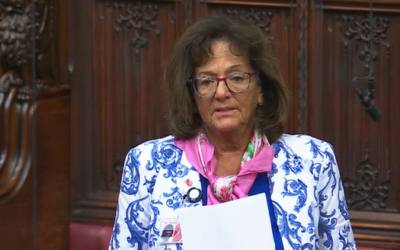
Lord Gold echoed points made previously by Lord Leigh when he pointed out that “the new sanctions purport to be global, but in reality they apply only to Israel…there have been no designations over Northern Cyprus, occupied by Turkey since 1974. The Xinjiang settler corporation in China is unsanctioned, and ministers have not said that the powers will be used against Hamas for diverting aid in Gaza or the Iran-backed Houthis who are detaining UN aid workers.”
Lord McCabe would later echo those sentiments, noting that “the foreign secretary tells us that we cannot outsource our moral responsibilities, and so he is taking the decision to act under our global human rights and international humanitarian law, but surely, unless we are going to see a raft of other measures, that sentiment could have a very hollow ring. What kind of moral responsibility does it show to act in one instance while turning a blind eye in many others?”
Lord Austin referred to a motion passed on Tuesday night by “Birmingham City Council’s Lib Dem and Green Coalition, supported, I have to say, by Labour councillors, passed a motion on divestment from Israel, including a review of pension fund investment and council banking relationships.
“Now, this, my lords, unbelievably, is a city which has had to be rescued from bankruptcy by taxpayers, where rubbish has been piled high in the streets, where it is the youth unemployment capital of Britain. Yet the clowns on the council are more concerned, obsessed with a war 3,000 miles away that they know next to nothing about and can do even less to solve. So, will the Minister make clear that this is not government policy? Will he confirm that the government’s opposition to boycotts of Israel applies to Labour councillors too?”
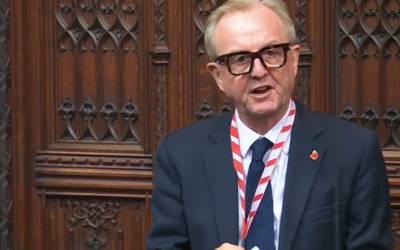
Lord Mendelsohn, who described Israel as being “the government’s current favourite target”, pointed out that “since the Clinton parameters, every serious peace proposal has envisaged Israel retaining major settlement blocks while compensating with land swaps. This does not excuse violence, dispossession, or unlawful expansion, but it recognizes the compromises and complexities on which peace has always depended, and the pursuit of it has always required. So…Is residential construction in those major blocks, in itself, a serious violation of international humanitarian law for the purposes of these regulations? If it is, what assessment have the government made of the effect on the prospects for a negotiated two-state solution? Have they assessed how restrictions on civilian and economic life in these same blocks might affect the prospects of an agreed territorial compromise?”
Lord Mendelsohn also noted that British “banks and insurers confronted with uncertain tests and grave penalties may well withdraw from perfectly lawful Israeli trade. Now, the government says it opposes boycotts. If British institutions withdraw from lawful trade with Israel as a whole. How is that different, in effect, from a boycott?”
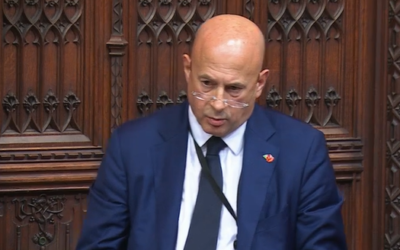
Answering on behalf of the government, Lord Wood maintained that “the Foreign Secretary, on 8 September, announced… many things, including which some noble lords have forgotten: a series of sanctions on financing arms of Hamas and Hezbollah. But he also announced two other things in particular… that there will be a new sanctions regime designed to stop UK economic activity supporting the expansion of illegal settlements, and that that will be laid before Parliament within six to nine months. Many comments of noble lords and noble ladies in the last hour have been focused on a bill that is yet to be produced and measures that have yet to be clarified.”
However, the motion of regret proposed by Lord Leigh narrowly passed, by 94 votes to 90.
Since Andy Burnham became Prime Minister in July, the UK has taken a harder line on Israel, with a corresponding further deterioration in the diplomatic relationship between the two countries. While it was widely believed that a change of government in Israel would potentially herald a tougher line on West Bank settler violence, the results in the Israeli elections last week mean it is unclear which parties will make up the coalition which will form the next administration.

Keep community journalism free.
Jewish News is free for everyone. No paywall. No barriers. Just trusted journalism for anyone who wants to stay connected to Jewish life in Britain.
If you value that, please support us.
From as little as £5 a month, you can help keep our journalism free and accessible to all.
Every day, we report on the issues that matter to our community. We celebrate achievements, support charities, challenge antisemitism and ensure Jewish voices are heard more widely.
From as little as £5 a month, you can help us continue to:
- Report on the stories shaping Jewish life in the UK and beyond
- Bring our community together through shared stories, events and campaigns
- Celebrate the people, culture and moments that define our community
- Support organisations doing vital work across Jewish Britain
You can make a one-off donation or become a regular supporter. Every contribution helps keep our journalism free, independent and accessible to all.
If everyone who values Jewish News gave a small amount, it would make a real difference to our future.