Prefer Jewish News on Google
Human bones found near former Nazi research site
The remains were found by the site of a former lab in which scientists performed research on death camp victims' body parts
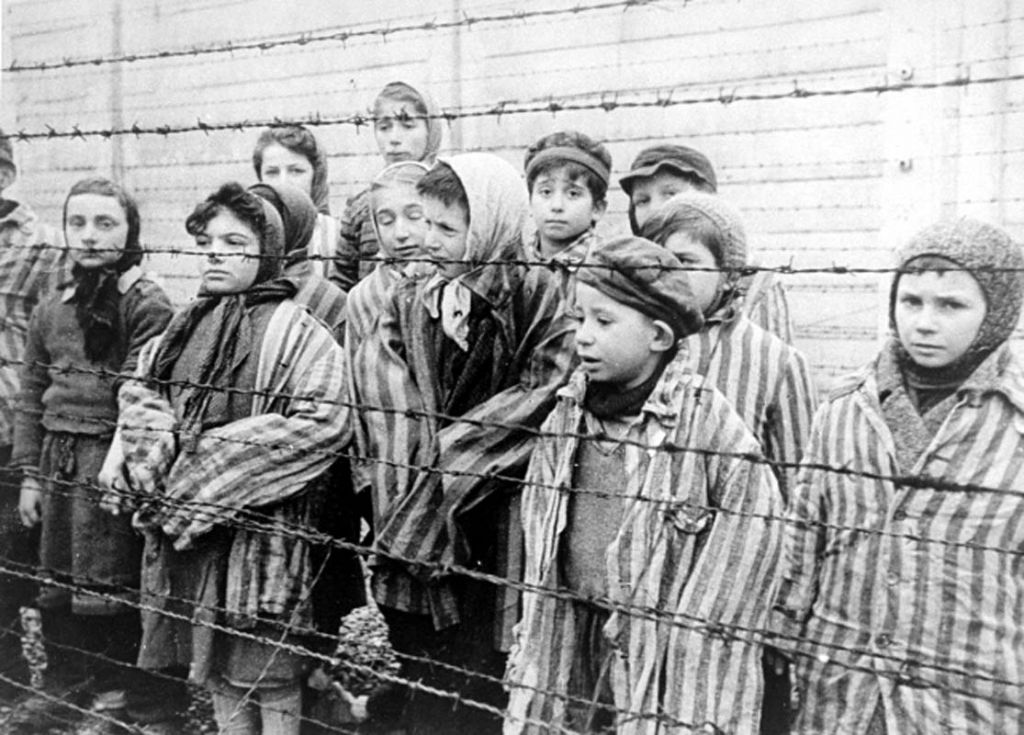
A large number of human bones have been unearthed in an upmarket part of Berlin close to where Nazi scientists performed research on death camp victims’ body parts.
The body parts were sent to the scientists by the notorious SS doctor Josef Mengele.
Experts have been examining the site in Dahlem since a small number of bones were found there in 2014 during works on a property belonging to Berlin’s Free University. Those bones were never identified.
They have found numerous fractured skulls, teeth, vertebrae and other bones, it was announced on Thursday.
The Nazi-era Kaiser Wilhelm Institute for Human Heredity and Eugenics was also known to have a collection of bones from German colonies, among others.

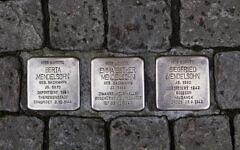

Experts are now trying to trace the origin of the bones found recently.
Several of the vertebrae found had traces of glue on them, indicating they may have been parts of skeletons on display.
The site is about 100 metres from what was the Kaiser Wilhelm eugenics institute in the Nazi era.
The world-famous Kaiser Wilhelm Society predated the Nazi era and once counted famous scientists like Albert Einstein among its directors.
But during the Nazi dictatorship, the institute was closely linked to pseudo-scientific race research, and Auschwitz physician Dr Mengele and others are known to have sent many body parts there for study.
Experts now plan to use osteological identification methods to try to learn more about the newly discovered bones.
They should at least be able to determine the general age of the person, their sex and how many different people’s bones were found, said Susan Pollock, a professor of archaeology at the university and one of the team leaders.
Results are not expected before the end of the year.
A working group of the university, the city, and the Max Planck Society, which the Kaiser Wilhelm Society was renamed after the war, has kept in close contact with Germany’s Central Council of Jews and Central Council of Sinti and Roma on the archaeological work.
Earlier this year, the Max Planck Society ordered a complete review of its specimens collection.
It had discovered human brain sections in its archive that were from victims of Nazi Germany’s so-called euthanasia program in which psychiatric patients and people with mental deficiencies were killed.
“The Max Planck Society has accepted a difficult legacy of its predecessor organisation, the Kaiser Wilhelm Society,” said society president Martin Stratmann of his organisation’s participation in the archaeological probe.
“We are well aware of the special responsibility that it entails.”

Keep community journalism free.
Jewish News is free for everyone. No paywall. No barriers. Just trusted journalism for anyone who wants to stay connected to Jewish life in Britain.
If you value that, please support us.
From as little as £5 a month, you can help keep our journalism free and accessible to all.
Every day, we report on the issues that matter to our community. We celebrate achievements, support charities, challenge antisemitism and ensure Jewish voices are heard more widely.
From as little as £5 a month, you can help us continue to:
- Report on the stories shaping Jewish life in the UK and beyond
- Bring our community together through shared stories, events and campaigns
- Celebrate the people, culture and moments that define our community
- Support organisations doing vital work across Jewish Britain
You can make a one-off donation or become a regular supporter. Every contribution helps keep our journalism free, independent and accessible to all.
If everyone who values Jewish News gave a small amount, it would make a real difference to our future.