Prefer Jewish News on Google
This is a tale of two marches.
Ostensibly, they were commemorating the same occasion: the Battle of Cable Street, the time the Jews of the East End, alongside their allies from the unions, the communists and the Irish dockers, stopped Oswald Mosley’s fascists from marching through the Jewish East End 90 years ago.
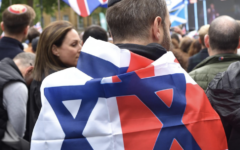
The first march was defiantly Jewish. It was led by the descendants of those who fought at Cable Street.
The second not only tried to erase Jews from the story but then turned on us. They accused us of being the new fascists. They screamed “Zionist scum off our streets” and physically tried to remove me from Cable Street. These people appropriated our history to attack us. We are way past irony.
For some years, Cable Street has become a touchstone for the story the Left and the far left tells itself about its proud history of antisemitism.
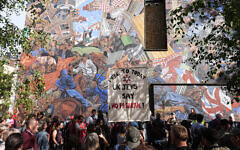
Jeremy Corbyn used to farcically insist that he could not possibly be antisemitic. Not only did he not have a single racist bone in his body, but his mother was at Cable Street. Ah, Cable Street! The romanticised version of the left’s civil rights movement against the fascists.
In their retelling, they came together to defend the defenceless Jewish community. The fact that Jews fought at Cable Street, that Jews led the Cable Street defence and had pleaded with their communist and socialist allies who were unwilling to give help isn’t part of their story.
In fact, in recent years, Jews haven’t been part of their version of the Cable Street story at all. Instead, it has become a kind of mushy, all-encompassing fight against racism.
There were two marches on Sunday because in the first one, organised by the union Unite, the word Jew wasn’t mentioned in the original announcement. The union apologised and signed up anti-Zionists Zack Polanski and Michael Rosen as speakers. Only the right kind of Jew was invited.
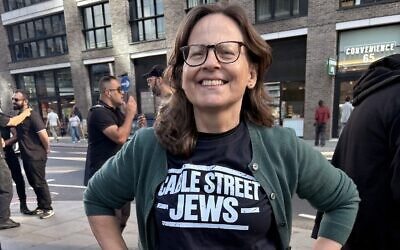
For Eve Kay, who earlier this year led protests against the attacks on Gail’s bakery in Holloway, this was too much.
“The fact the Unite leaflet about Cable Street didn’t mention Jews made me so angry that I decided, along with friends and Jewish activists, to organise a commemoration that put Jews front and centre of their own history”, she said.
“It is an important day for both Jewish and working-class history. It was a day that started in shame because the leadership of the Labour Party and the trade unions abandoned the Jews of the East End but it ended with honour because the ordinary people, the ordinary trade unionists, dockers, Community Party members, and resident joined with their Jewish neighbours defending their streets from the fascists.
“In some ways today we still have the shame and the honour. We have been attacked for being the wrong kind of Jew by the official organisers, but we’ve got the honour of standing up to these assaults and campaign of vilification with a brilliant turnout.”
The march is estimated to have been 1,000 strong. Cath (who asked for only her first name to be used) was among the non-Jewish allies there. “The final push for me was seeing the way the plane hijacking was reported – as if it was just a brawl and the Israelis were making things up. I knew I had to be here,” she said.
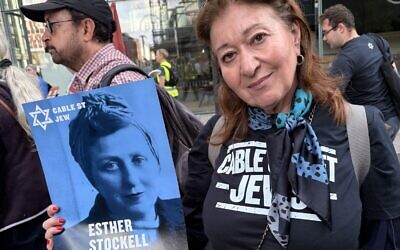
For Debby Lee, whose grandparents Esther and Moishe Stockell were at Cable Street and who has helped organise some of the cultural activities around the event, it was important to mark this milestone in British Jewish history the right way.
“This is a moment in history we should all be proud of,’ she said. “This is not about Israel and what is happening in the Middle East but about our history. My grandparents were early members of the trade union movement; they were staunch communists and Zionists. My mum said my grandparents used to talk about it a lot.”
Michael Bennett, a sprightly 94-year-old, who was at the original battle, was among those marching: “The lesson of Cable Street is that we must stand up for ourselves and fight,” he said.
At first the plan had been for a Jewish bloc at the main demonstration. But Unite seemed unwilling. Just a few days before the event, the official Cable Street 90 Organising Committee released an inflammatory press release which, shockingly, accused the Jewish groups of fascism and proximity to Tommy Robinson and said its members were “not welcome” on the Cable Street 90 march and rally.
Michael Rosen tweeted out: “I heard on the grapevine that organisations related to Tommy Robinson’s groups were considering doing something provocative. Are they not ‘far right’?”
He could not be more wrong. None of the organising groups were far right.
The only provocative thing that happened was that we were there.
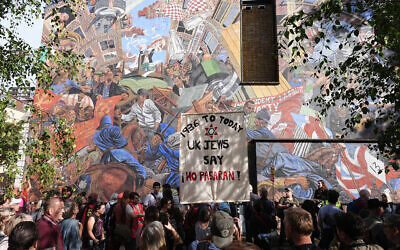
The march moved in comradely spirit, even when there were several waits as roads – including Cable Street – had to be closed because the crowd was so much bigger than envisaged. As this march ended, the other was starting in a different direction: one police officer told me his colleagues were already having problems with them as they were refusing to take off face masks. There were no face masks on the Jewish run demonstration. There was no need.
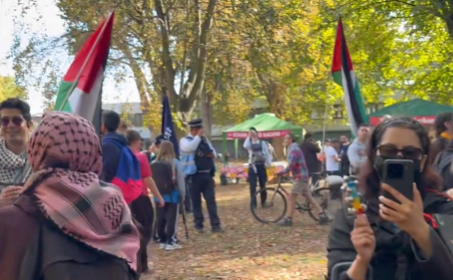
An hour after the first demonstration had dispersed, the second came into the small park next to the Cable Street Memorial, where a stage had been set up. Problems began from the start: a few people wearing T-shirts from the first march were pushed away by this keffiyeh-brandishing crowd.
As the demonstration, of around 400 people, came into view, there were disputes among them. One man pleaded: “Look, I’m an anti-Zionist Jew, but that is not on. Today is meant to be about unity.”
His comrades not only ignored him, but one grabbed a loudspeaker and started screaming, “Zionism is fascism! Zionism is fascism!”
Inside the park, they spotted me. “You are a Zio!” one shouted. Again with the loudspeaker, “Zionists are not welcome here.”
People told me to move. I tried to point out the hypocrisy of trying to tell a Jewish woman to move from Cable Street while holding a “No Pasaran” banner. One tried to push me away with his placard.
So they decided to surround me with the “No Pasaran” sign while screaming, “Zionist scum off our streets”.
Later on, a “Stand up to Racism” steward, who had been tapping me with her placard, but denied this, said, “You are a racist Zionist woman! You need to leave! You are here to cause trouble.” And she warned, “If I touched you, you wouldn’t be alive.”
More stewards moved her away. I stayed to listen to Michael Rosen and Jeremy Corbyn drone on. By the time the crowd was whipping itself up into a new “Free Free Palestine” frenzy, it was time to leave.
The racist anti-racists had shown their true colours. I’d had an inkling of what it must have been like for our ancestors – including my great uncle – who were at Cable Street. Whether it’s the fascists of the left or the right, the hatred feels the same. It is dangerous and frightening and we don’t know where this ends.

Keep community journalism free.
Jewish News is free for everyone. No paywall. No barriers. Just trusted journalism for anyone who wants to stay connected to Jewish life in Britain.
If you value that, please support us.
From as little as £5 a month, you can help keep our journalism free and accessible to all.
Every day, we report on the issues that matter to our community. We celebrate achievements, support charities, challenge antisemitism and ensure Jewish voices are heard more widely.
From as little as £5 a month, you can help us continue to:
- Report on the stories shaping Jewish life in the UK and beyond
- Bring our community together through shared stories, events and campaigns
- Celebrate the people, culture and moments that define our community
- Support organisations doing vital work across Jewish Britain
You can make a one-off donation or become a regular supporter. Every contribution helps keep our journalism free, independent and accessible to all.
If everyone who values Jewish News gave a small amount, it would make a real difference to our future.