Prefer Jewish News on Google
Israeli pupils discover 3,000-year-old scarab on school trip near Tel Aviv
A figure is depicted on the artefact with what appears to represent the crown of an Egyptian pharaoh.
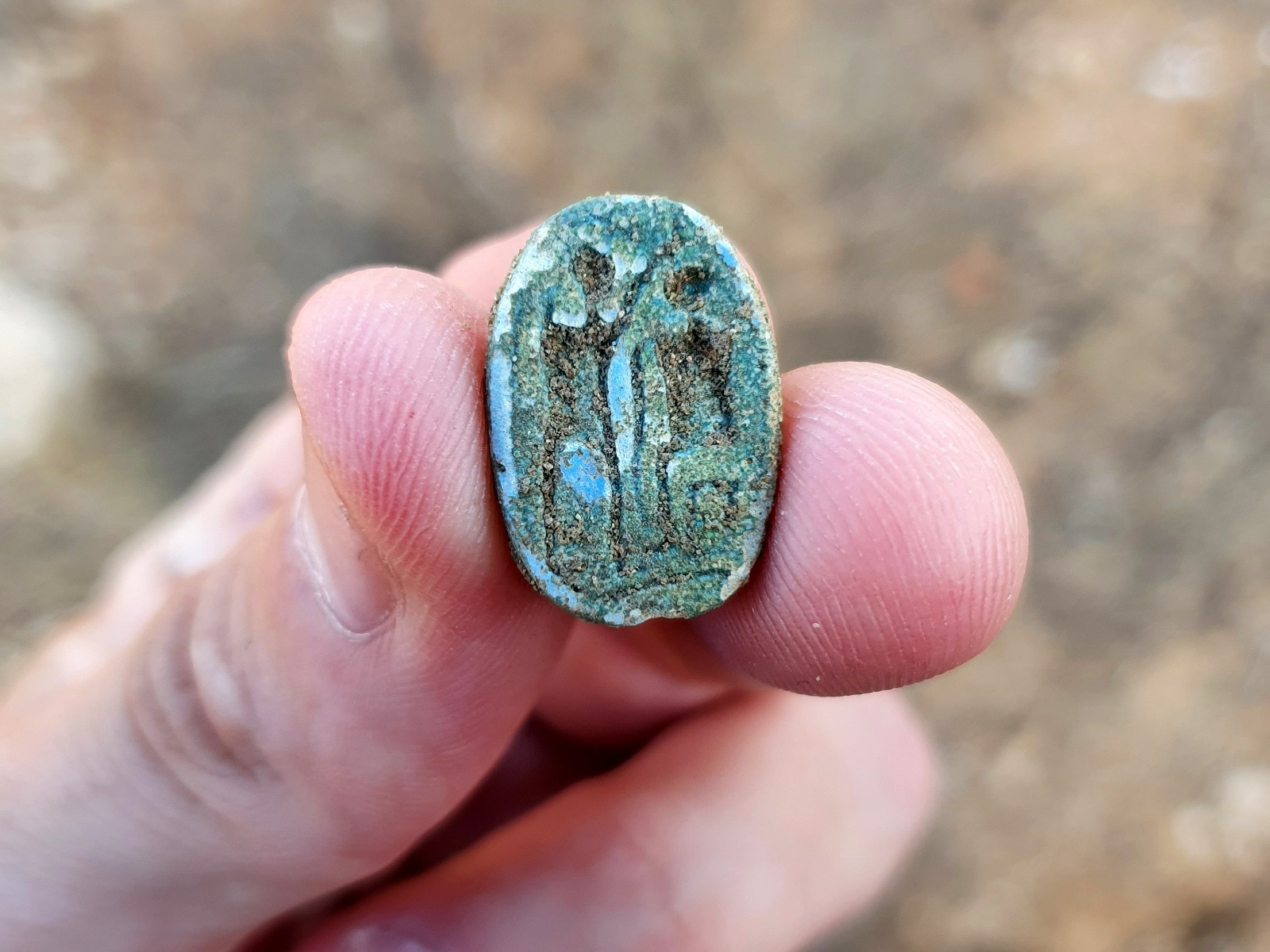
Israeli eight-grade students have discovered a 3,000 year old scarab on a tour outside Tel Aviv, depicting what appears to be an Egyptian Pharaoh.
The students found the scarab on a tour organised by the Israel Antiquity Authority in Azor, some five miles southeast of Tel Aviv.
“We were wandering around, when I saw something that looked like a small toy on the ground. An inner voice said to me: ‘Pick it up and turn it over.’ I was astonished: it was a scarab with a clearly incised scene, the dream of every amateur archaeologist. The pupils were really excited!” said Gilad Stern of the Israel Antiquity Authority Educational Center, who was leading the tour.

pupils from the Rabin Middle School in Azor. Photo: Gilad Stern, Israel Antiquities Authority.
A figure is depicted on the scarab, which is designed in the shape of the common dung beetle, sitting on a chair. In front of it is a standing figure, with what appears to represent the crown of an Egyptian pharaoh.
Israel Antiquity Authority believes it could be a snapshot of a scene wherein the Egyptian Pharaoh is conferring authority to a local
Canaanite subject.

“This scene basically reflects the geopolitical reality that prevailed in
the land of Canaan during the Late Bronze Age (ca. 1500-1000 BCE), when the local Canaanite rulers lived (and sometimes rebelled) under Egyptian political and cultural hegemony. Therefore, it is very possible that the seal is indeed from the Late Bronze Age, when the local Canaanites were ruled by the Egyptian Empire,” said Dr. Amir Golani, Israel Antiquities Authority specialist of the Bronze Age period.
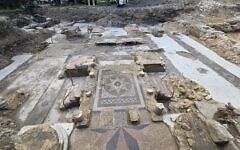
While scarab seals are distinctly Egyptian, hundreds were discovered in Israel, mainly in graves, but also in settlement layers.
“The scarab was used as a seal and was a symbol of power and status. It may have been placed on a necklace or a ring. It is made of faience, a silicate material coated with a bluish-green glaze,” Dr. Golani added.
“It may have dropped from the hands of an important figure of authority who passed through the area, or it may have been deliberately buried in the ground along with other objects, and after thousands of years it came to the surface. It’s difficult to determine the exact original context.”

Keep community journalism free.
Jewish News is free for everyone. No paywall. No barriers. Just trusted journalism for anyone who wants to stay connected to Jewish life in Britain.
If you value that, please support us.
From as little as £5 a month, you can help keep our journalism free and accessible to all.
Every day, we report on the issues that matter to our community. We celebrate achievements, support charities, challenge antisemitism and ensure Jewish voices are heard more widely.
From as little as £5 a month, you can help us continue to:
- Report on the stories shaping Jewish life in the UK and beyond
- Bring our community together through shared stories, events and campaigns
- Celebrate the people, culture and moments that define our community
- Support organisations doing vital work across Jewish Britain
You can make a one-off donation or become a regular supporter. Every contribution helps keep our journalism free, independent and accessible to all.
If everyone who values Jewish News gave a small amount, it would make a real difference to our future.