Prefer Jewish News on Google

It is up to us to carry Harry Olmer’s legacy onwards
Harry was in the truest sense of the word, a mensch. In his passing we have lost a friend and a guiding voice
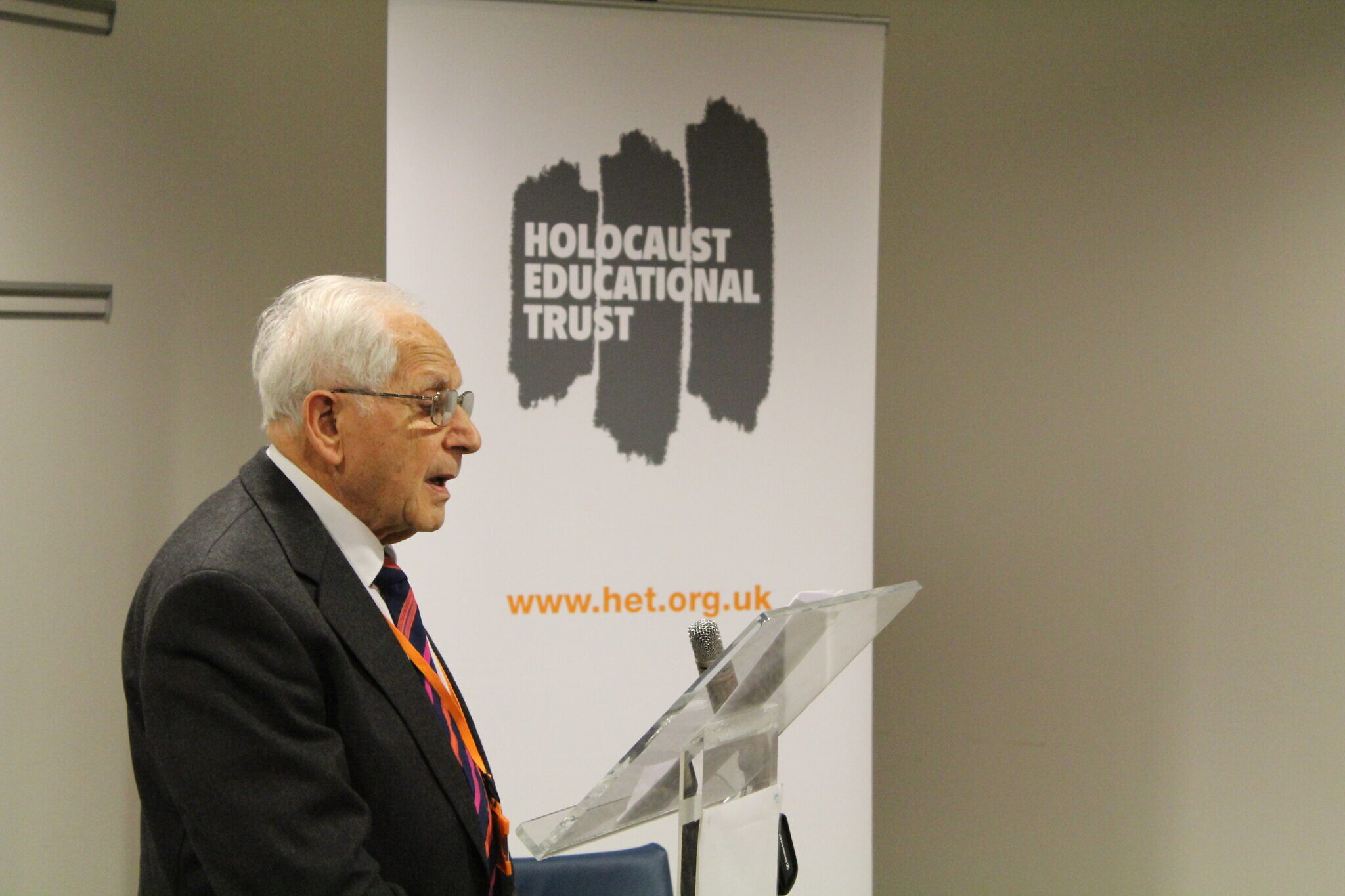
A zest for life – that’s what comes to mind when I think of the inspiring Harry (Chaim) Olmer MBE.
I’m always astonished by the great age of many of our wonderful Holocaust survivors. The energy they have long into their late 90s is awe-inspiring. But this is true of Harry especially – he attended every event he could, was always one of the last to leave and he worked the room! He loved being amongst people and we loved having him with us. Well into his 90’s, Harry was on the dancefloor at 45 Aid Society reunions and he joined the annual March of the Living – he did these physical and emotionally challenging trips without question.
While that all sounds surprising, in Harry’s case, it is unquestionably characteristic of this brilliant man. Harry was charming, charismatic, thoughtful, kind and so much more. He was never without a smile and a glint in his eye. Not only this, he had a tenacity, an inner strength and quiet resolve that fuelled an indefatigable zest for life which kept him going and gave him a spring in his step.
In the past year, Harry’s health declined, but he didn’t slow down, he was harder to convince to rest. This is because he was on a mission – to educate and to make us remember. His stubborn determination always shone through.
Harry’s early years were marked by unimaginable suffering and loss.

In 1942, Harry, his father and brother, were sent to Plaszow labour camp in Krakow. From here, Harry was deported to Skarżysko-Kamienna, where he was one of tens of thousands of Polish Jews forced to work in chemical factories filling shells and land mines with acid. He was only 16 years old. The work was incredibly dangerous and would often turn the prisoners’ skin yellow.
In July 1944, a final selection took place, and Harry was sent to Schlieben, a subcamp of Buchenwald. In April 1945, the prisoners were moved yet again, this time to Terezin in Czechoslovakia. Finally, after years of exhausting, dangerous forced labour, starvation, selections, brutality and endless fear, Harry was liberated by the Soviet Army on 8th May 1945. From his entire family it was only Harry and his two siblings, Sarah and Joe, who were left remaining at the end of the war.
Harry came to the UK as one of ‘the Boys’, a group of child survivors, many of whom became lifelong friends. Harry said that his three months recuperating in Windemere helped him to learn to live again.
And what a life he lived. He studied to become a dentist, reluctantly retiring at the age of 86. He married Margaret, had four children, grandchildren and great grandchildren. He always ended his talks to schools by showing a photo of his family with pride and declaring this as his revenge on Hitler.
Living proudly as a devoted Jew was his greatest rebellion and most honoured triumph. And what a lesson for us all – what a legacy.
He did not just learn to live again; he showed us what it means to live a good and joyful life. Harry was in the truest sense of the word, a mensch. In his passing we have lost a friend and a guiding voice. It is up to us now to carry his legacy onwards and ensure that the horrors he endured are remembered for generations to come.
Whenever Holocaust survivors pass away, we feel their loss deeply and are reminded of the urgency of Holocaust education and just how special these remarkable individuals are. With Holocaust Memorial Day approaching, Harry’s passing is even more poignant. I will always remember Harry, all he endured and all he achieved, with love, admiration and appreciation.
May his memory be a blessing.
Karen Pollock CBE is Chief Executive of the Holocaust Educational Trust

Keep community journalism free.
Jewish News is free for everyone. No paywall. No barriers. Just trusted journalism for anyone who wants to stay connected to Jewish life in Britain.
If you value that, please support us.
From as little as £5 a month, you can help keep our journalism free and accessible to all.
Every day, we report on the issues that matter to our community. We celebrate achievements, support charities, challenge antisemitism and ensure Jewish voices are heard more widely.
From as little as £5 a month, you can help us continue to:
- Report on the stories shaping Jewish life in the UK and beyond
- Bring our community together through shared stories, events and campaigns
- Celebrate the people, culture and moments that define our community
- Support organisations doing vital work across Jewish Britain
You can make a one-off donation or become a regular supporter. Every contribution helps keep our journalism free, independent and accessible to all.
If everyone who values Jewish News gave a small amount, it would make a real difference to our future.