Prefer Jewish News on Google
Lord Hermer: Labour under Starmer has ‘no place for antisemitism’
Attorney General praises PM's leadership, and dismisses ECHR exit at JLM conference appearance with Tom Baldwin

Lord Hermer has spoken candidly about his own experiences of antisemitism and his belief that this poison can only be effectively challenged by standing shoulder to shoulder with communities impacted by forms of racism and prejudice.
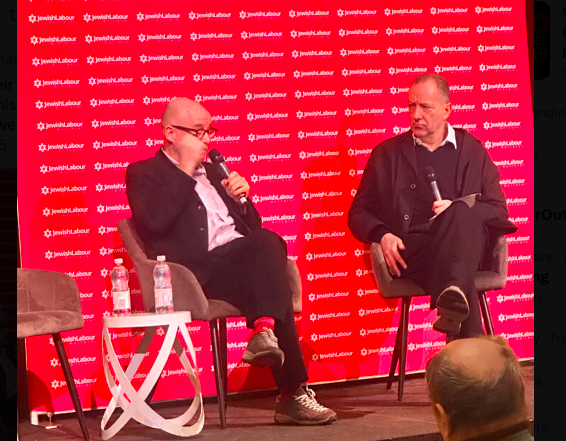
In a revealing conversation with author and journalist Tom Baldwin at the Jewish Labour Movement’s annual conference, the Attorney General also launched a staunch defence of the “resilience” of his friend Keir Starmer, confidently predicting “he’ll be our prime minister, leading us into the next election.”
The human rights barrister also addressed concerns about the UK’s position in relation to the European Court of Human Rights and Council of Europe, insisting it would be a “disaster for this country” to leave these institutions, while recognising a debate with fellow members “has come up in the context of irregular migration across the continent.”
Hermer, a prominent human rights barrister, reflected on his upbringing in Cardiff’s “small but thriving Jewish community,” recalling that he “only experienced one antisemitic teacher” as a child. However, “after getting involved in student politics and anti-fascist activity, the negative experiences increased.”
He explained, “I certainly faced it when I was dealing with the BNP. And then I went to the Bar, so I’m in a very privileged position, but you still get things. You still get it both from the left and the right, the people who confuse you with another Jewish person that they know.”


Hermer shared a recent example: “For example, the comment I had about two weeks after October 7 at an impeccably progressive event in which someone referred to what was then the initial stages of the Israeli response as ‘a Holocaust.’”
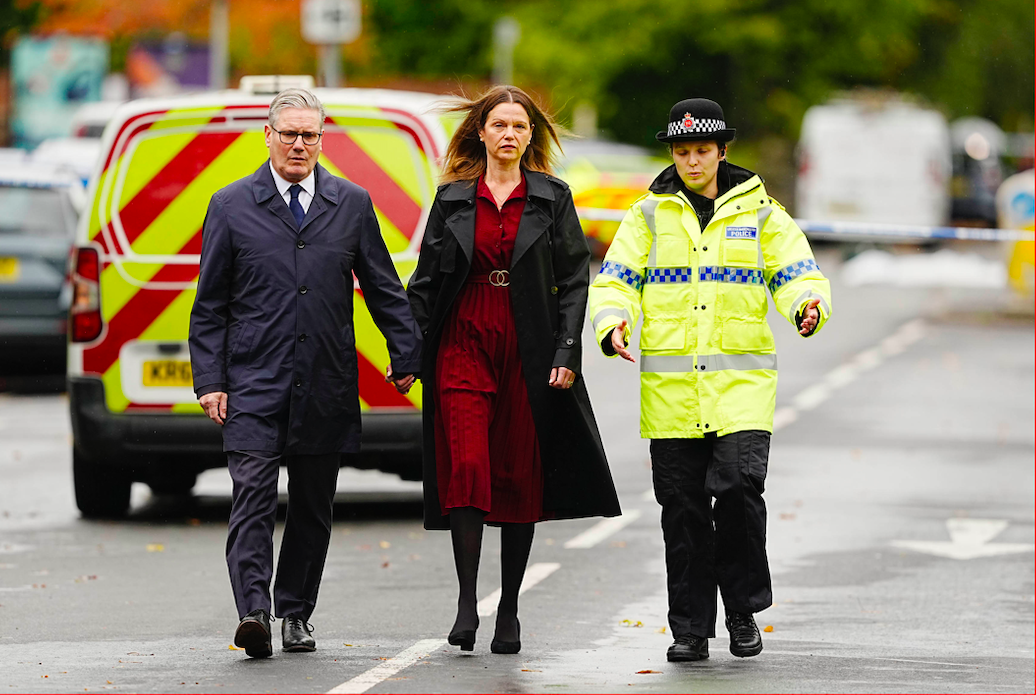
He reflected on a decision to write a article for Jewish News in the immediate aftermath of the Heaton Park synagogue terror attack.
“My eldest is at university in Manchester,” he reflected. “I knew she was getting to synagogue that day. I was actually in Dublin.
“And I just wanted to convey what I felt, which was this kind of mixture of anger, bewilderment, determination, and I wanted to convey it to my own community, and I wanted to convey it as Attorney General and a member of the cabinet to my own community.”
The KC added:”I think I can do that. I can bring not just in terms of responses to antisemitic outrages, but my whole kind of Jewish experience to who I am, and that comes as part of my contribution around the Cabinet table.
“In the same way that all of us, as we sit around there, bring our own life experiences to make sure that what we’re doing reflects that reflects the people that we are.”
Hermer also acknowledged, “there are lots of unique elements to antisemitism that separate it from other forms of prejudice and racism,” citing historian Ralph Hilberg.
Yet, he stressed, “You can identify parts of it that are unique, but it has always been absolutely core to me, both as someone who wants to find pragmatic ways to address problems, but also someone who has a core belief that you cannot either understand antisemitism nor fight it unless you are also fighting all other forms of prejudice and discrimination.”
“And so for me as a young person,” he continued, “when I kind of first became politically active, which was in my mid-teens, and that was through apartheid, I became passionate about involvement in the anti-apartheid movement, motivated by being really engaged in Jewish youth movements.”

Hermer spoke about a friend’s experience, saying, “At school, where the teachers thought he could play sport but wasn’t going to be a brilliant lawyer like that, kind of direct, ingrained discrimination never ever impacted upon me.”
He also highlighted, “Or the day-to-day acceptability of anti-Muslim bigotry that you see in the media now, that if we translated Muslim to Jew, would just be thought of as utterly vile and antisemitic. Now that’s all of our problem, and we’re only going to address it when we work together.”
Reflecting on his time with the Union of Jewish Students and the National Union of Students, Hermer said, “there was a major problem with left-wing antisemitism.” He added, “We obviously had a huge problem under Jeremy Corbyn,” but credited Starmer: “he had made this one of his defining projects when he became leader of the party … and within a short space of time, he had turned our party around.”
“No place, no quarter for antisemitism,” Hermer stated proudly.
“That’s something that Keir believes in passionately, and he has set about it methodically to change the Labour Party. Is it fixed? … You can never be complacent. Never. But have we moved on beyond recognition from the point at which the Labour Party, to its great shame, is referred to the EHRC.”
Turning to Starmer’s leadership, Hermer said, “Keir is the most resilient person that I have ever met, and I think we should all be thankful that he is. … I sleep soundly at night knowing that Keir is Prime Minister.”
He continued, “He will face brickbat after brickbat, and I have never … witnessed him, allowing any of that to distract from his job.”
He admitted, “I’d never understood the gravity, the degree of responsibility that a prime minister bears, until I joined the government, and until I, frankly, became a member of the National Security Council on day one.”
When asked by Baldwin if Starmer would still be Prime Minister next year, Hermer replied, “Keir will be Prime Minister this time next year at JLM, and he’ll be our Prime Minister, leading us into the next election. And I am absolutely convinced that we will win the next election.”
“It would be madness. madness, to carry on engaging in the debate about internal Labour Party politics. We were not elected to do that,” he argued.
“We were elected to move the country on from the farce of the years of Tories not caring about the country, but caring about their own internal politics, and we were elected to move away from that, and we will be doing that in the months and years ahead. There should be no mistake about that.”
Asked to describe the narrative of Starmer’s government, Hermer said, “I would identify two aspects as to what the Labour project is about and will remain. The first is a fundamental belief in human dignity and a belief that everybody in society deserves a fair crack of the whip. And the second is that government has an important and indeed central role in enabling that, and that to enable it, we have to affect long-term structural change.”
He continued: “Now, I think when you look back at the first 18 months in government, fairly and objectively, people will see that we have started laying in place the foundations of that structural change that would allow people to live their life with dignity. And I think we’re doing that in every aspect of people’s lives.
“We’re bringing in across the country free school meals. We’re having a uniform cap. We’re increasing nursery places. We’re making it easier for parents and cheaper for parents to have childcare, a fundamental change. Dignity on the streets. Crime is falling. We got more policemen out there. That’s all about giving people a sense of safety and pride.
“So as you walk down a safer street, the streets are looking better, not a quick fix, not a 24-hour news cycle headline, but fundamental, fundamental change.”
Hermer described Starmer as “way too modest” to want anything described as “Starmerism.”
He explained, “It’s just not his style. But if you ask me, what is Starmerism? It is that sense that everybody deserves dignity and a fair crack at the whip. Just as he is informed by his own background, the role of government is to provide it.”
He offered a personal example: “Keir’s constituency, obviously, is a local one, and he talks with extraordinary passion about his experience of standing in Somerstown, which is one of the most deprived areas of the city. Across the literal railway tracks from SomersTown, you can see the new Google landscaper build up. Keir says both, I think he would have described it as anger when in opposition, but determined now he is Prime Minister to ensure that parents and children look across that railway track, no longer thinking this is not a world for me in that beautiful building, but thinking that’s for me. That is what motivates Keir.”
On suggestions that Starmer is seeking changes to the European Convention on Human Rights (ECHR), Hermer was unequivocal: “Look, we’re not seeking to make changes to the ECHR, and we’ve been very clear about that. So the ECHR sets out basic, fundamental human rights, the right to life, the right to a fair trial, the right to a private life, all things in the convention that actually also existed in our own common law traditions for centuries. And we are not seeking to change that. The Prime Minister has been very clear, we will not be leaving the European Convention of Human Rights or the Council of Europe.”
To do so, he said, would be “a disaster for this country.” Instead, Hermer explained, “What we are engaging with at the moment within the Council of Europe is a discussion with our colleagues on how we can best ensure the convention remains as relevant as possible going forward. And that’s a debate that has come up in the context of irregular migration across the continent. Now, none of us is saying that the convention needs to be changed.”
He continued:“To deal with that, we’re saying a number of things. Firstly, we’ve got to make sure that the way the convention is interpreted reflects the challenges that all societies across Europe are facing.
“Secondly, we’ve got to work together with the 46 countries in the Council of Europe to coordinate our responses to irregular migration, and it’s only through coordination across the continent that we’re going to deal with it.
“And we also have to look forward to the future where the challenges and the extent and the intensity of irregular migration, not least as climate change kicks in, is going to be ever more intense, so we are working together. Ever thinking together to fashion solutions together.”
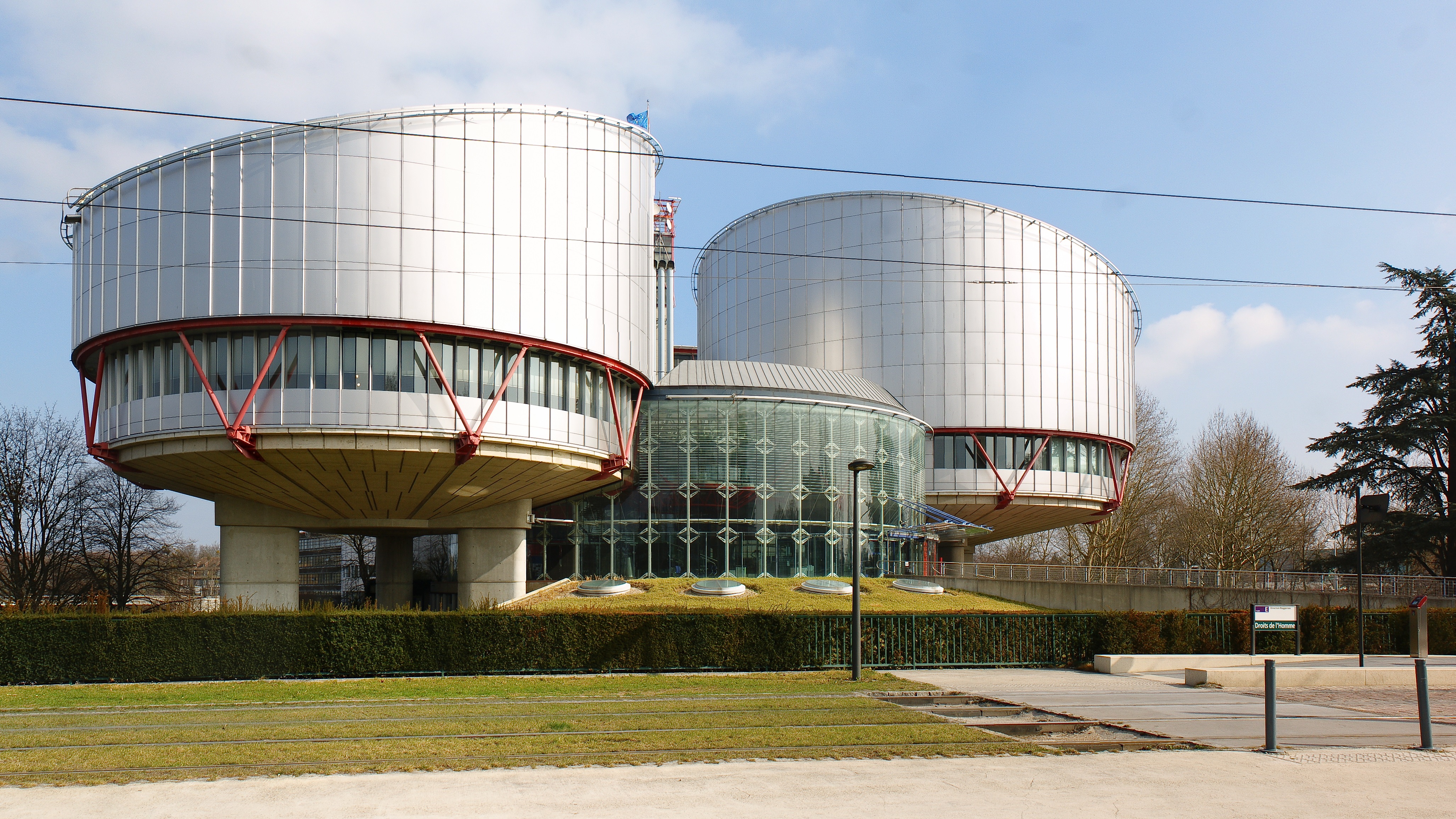
Hermer was adamant that “none of that is undermining the European Convention, none of that is undermining the Council of Europe.”
He reasoned:”It is ensuring its ongoing vitality, because the European Convention is kind of a bedrock of Europe, the only two people who have chosen to leave it are Russia and Belarus.
“The only other country that is even talking about it is this country, because of the position taken by reform and astoundingly, the Conservative Party, notwithstanding that the Council of Europe was, in large measure, the creation of Churchill.”

Keep community journalism free.
Jewish News is free for everyone. No paywall. No barriers. Just trusted journalism for anyone who wants to stay connected to Jewish life in Britain.
If you value that, please support us.
From as little as £5 a month, you can help keep our journalism free and accessible to all.
Every day, we report on the issues that matter to our community. We celebrate achievements, support charities, challenge antisemitism and ensure Jewish voices are heard more widely.
From as little as £5 a month, you can help us continue to:
- Report on the stories shaping Jewish life in the UK and beyond
- Bring our community together through shared stories, events and campaigns
- Celebrate the people, culture and moments that define our community
- Support organisations doing vital work across Jewish Britain
You can make a one-off donation or become a regular supporter. Every contribution helps keep our journalism free, independent and accessible to all.
If everyone who values Jewish News gave a small amount, it would make a real difference to our future.