Prefer Jewish News on Google
OPINION: The meeting that haunts Netanyahu to this day
Netanyahu cannot accept that the Palestinian Authority, flawed, faded, and frozen in time as it is, has re-emerged as the only plausible alternative to chaos
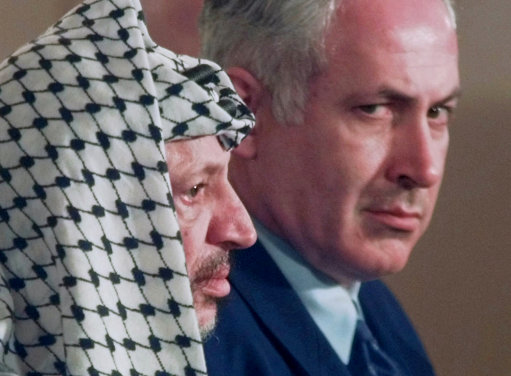
On 4 September 1996, I stood in the conference room at the Erez Crossing, coordinating the media coverage as Prime Minister Benjamin Netanyahu shook hands with Yasser Arafat. It was Netanyahu’s first meeting with the Palestinian leader after his election earlier that summer, and it was a moment heavy with history, hesitation, and reluctant hope.
The handshake was brief, tense, and transactional. It wasn’t peace. It wasn’t even reconciliation. It was necessity, an unavoidable engagement with the reality of Palestinian political power in Gaza and the West Bank. For a prime minister elected on a platform opposing the Oslo Accords, the image was jarring. But for a moment, Netanyahu acknowledged the Palestinian Authority as the player he had to deal with.
Nearly three decades later, that image has become a political ghost. Today, Netanyahu refuses even to entertain the idea of allowing the Palestinian Authority to return to Gaza, not because they are incapable, but because their return would expose the utter bankruptcy of the policy he has pursued ever since that uncomfortable meeting at Erez.
For 15 years, Netanyahu has built his political strategy around two core assumptions: that the Palestinian Authority is corrupt, weak and irrelevant, and that Hamas, though dangerous, is containable. He nurtured the Palestinian political divide, weakening Ramallah while tolerating Gaza as a “hostile entity” that justified eternal vigilance but didn’t demand a political solution.
This was not a mistake, it was a deliberate architecture. Netanyahu repeatedly insisted there was “no partner” in Ramallah, and pointed to the internal Palestinian split to prove it. He used the division to reject diplomacy, deny Palestinian statehood, and maintain control.


Then came 7 October. The bloodiest day against the Jewish people since the Holocaust. The myth of containment shattered. The “manage the conflict” doctrine lay in ruins. And suddenly, the Palestinian Authority, flawed, faded, and frozen in time, has re-emerged as the only plausible alternative to chaos.
Let’s be clear: the PA is no saviour. It is plagued by corruption, authoritarianism, and a legitimacy crisis. It has failed to renew its leadership or win back the trust of its people. Its security coordination with Israel, while good for Israel, has earned it scorn in the Palestinian street.
But the PA also possesses what no one else in the Palestinian arena does: recognition, structure, and experience. It governs cities, runs ministries, coordinates with donors, and maintains a trained civil service. It supports a two-state solution and engages with the world diplomatically. It is, for better or worse, the framework upon which any political future must be built.
That is precisely what Netanyahu cannot accept.

Bringing the PA into Gaza after Hamas is dismantled would be a political earthquake for Netanyahu. That’s why he has chosen the path of armed clans and gangs. To bring back the PA to Gaza would be an admittance that his policy of division was a failure. That Hamas was not contained. That the Palestinian Authority, whom he dismissed and derided, was not the problem, but part of the solution.
It would also mean confronting the idea he has spent a career burying: that there is a Palestinian partner, that the conflict is political, not eternal, and that Israel must make choices about the future, not just repeat security operations indefinitely.
Netanyahu isn’t ready for that reckoning. So he stalls. He instructs – against the recommendation of IDF Chief of Staff Lieutenant General Eyal Zamir – to take control of Gaza City. He talks about “security envelopes” and indefinite Israeli control. He offers no roadmap, just a political holding pattern disguised as military necessity.
But this moment is bigger than Netanyahu. Just as that handshake at Erez was a reluctant acknowledgment of reality, so too is the choice Israel faces today: perpetuate the cycle, or pivot to something new.
The PA must reform, but it must also be empowered. Israel must protect its own citizens, but it must also make political decisions. And leadership, real leadership, means being willing to admit what went wrong and chart a better course.
For Netanyahu, that might be a bridge too far. But for Israel, it’s the only path forward.
Lieutenant Colonel (R.) Peter Lerner is the Director General of International Relations of the Histadrut. He served for 25 years in the IDF as a spokesperson and a liaison officer to international organizations in the West Bank and the Gaza Strip. X: @LTCPeterLerner

Keep community journalism free.
Jewish News is free for everyone. No paywall. No barriers. Just trusted journalism for anyone who wants to stay connected to Jewish life in Britain.
If you value that, please support us.
From as little as £5 a month, you can help keep our journalism free and accessible to all.
Every day, we report on the issues that matter to our community. We celebrate achievements, support charities, challenge antisemitism and ensure Jewish voices are heard more widely.
From as little as £5 a month, you can help us continue to:
- Report on the stories shaping Jewish life in the UK and beyond
- Bring our community together through shared stories, events and campaigns
- Celebrate the people, culture and moments that define our community
- Support organisations doing vital work across Jewish Britain
You can make a one-off donation or become a regular supporter. Every contribution helps keep our journalism free, independent and accessible to all.
If everyone who values Jewish News gave a small amount, it would make a real difference to our future.