Prefer Jewish News on Google

The Lancaster House Conference was impressive, but the hour is late
Analysis: A major gathering of Jewish and non-Jewish societal stakeholders on the subject of combating antisemitism was important to have, but ultimately actions are needed
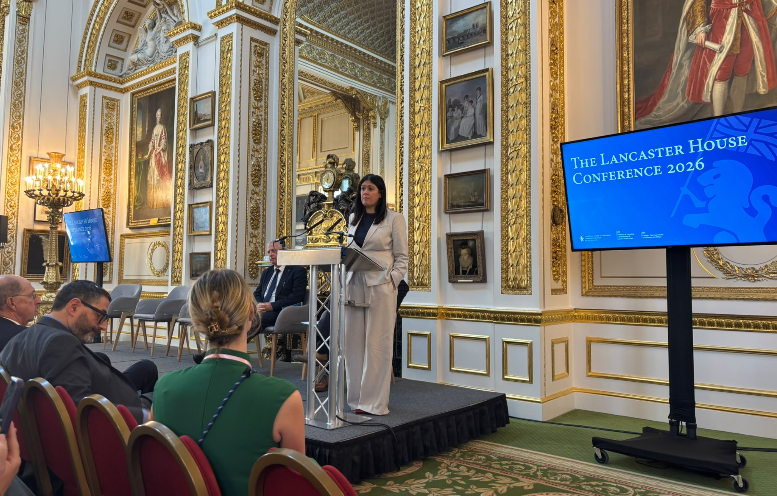
The Lancaster House Conference held on Tuesday was both a triumph and an admission of failure.
The failure was not on the part of the event’s organisers, but rather the fact that such a conference needed to be held at all. Antisemitism in the UK has surged in recent years, with the terrible events of 7 October 2023 and the subsequent destruction in Gaza allowing antisemites to give free reign to their prejudice. Major reports on antisemitism in the NHS and in education have recently been released. These are not dispassionate studies, but the everyday experiences of British Jews writ large. And they should shame wider society.
That being said, the conference itself was impressive – not so much for the number of the government ministers there (as well as three different Secretaries of State over the course of the day) as for the evidence of the extent to which British Jews have, within the space of a few years, built up an entirely new set of mechanisms to try and combat the bigotry they are facing. In healthcare, NHS Trusts across the country now have Jewish staff groups. In sports, a wide variety of different clubs now have specific Jewish supporters organisations. Jewish staff networks have been set up within other professions, allowing people to come together in adversity and share best practice techniques to mount a successful defence against hate. Many of these were represented at Lancaster House.
However, the frustration was palpable. Government has made it clear that it is listening, and that it accepts the findings of the different reports into antisemitism and will act. But it has taken more than three years now to get to this point, and many Jews are physically and mentally exhausted; they continue fighting simply because they cannot afford to give up.
At this point I would like to simply share with you one of the testimonies that was given at the conference:



“I worked in a hospital setting. A colleague of 14 years who had previously been one of my students and had even shared meals in my home, began posting blatantly antisemitic tropes on social media. Among other things, she posted claims that Jews kill babies and drink their blood. This was particularly difficult because we work in a neonatal unit.
“I contacted her privately, asked her to reconsider what she had posted, and maybe remove it from public domain. She ignored my requests. I then gave her 24 hours to reconsider, explaining that if she refused, I would contact Prevent. She chose not to remove the posts, so I followed through. The trust’s response was that it had no concerns about her posts because they had been made on her personal social media account, instead mediation was suggested. Reluctantly, I agreed.
“We spent approximately four hours in face-to-face mediation. Throughout the meeting, her repeated response was, ‘I have done nothing wrong. I have offended nobody’. Even the mediator appeared increasingly frustrated by her refusal to acknowledge the issue. Eventually, I walked out because it was clear that we were getting nowhere. I had already reduced my original request from asking her to remove the posts to simply acknowledging that she had caused offense to me personally. Even that she refused to do. Today she holds a governance lead position, yet her views have not changed. I feel this puts me in a particularly difficult situation at work, especially as governance has such an impact on everything we do.
More recently, I undertook further training… with a senior colleague acting as my mentor. We were working together in the clinic when a young couple who were visibly Jewish attended with the usual questions and concerns about their child’s tongue tie. After they left, my colleague leaned towards me and whispered, ‘I can’t wait until North Manchester opens up their own tongue-tied clinic. Then I won’t have to deal with those Jews anymore’. I turned to her and asked, ‘You do know I’m Jewish, don’t you?’ To which her response was, ‘Yeah.’
Once again, the trust took no meaningful action. I subsequently submitted a formal complaint. I received a printed apology that was neither signed nor, as far as I could tell, was written by her. Later, due to other work-related matters, I lodged a formal grievance against her on the grounds of bullying and harassment. However, the trust refused to allow me to cite the antisemitism, claiming that the matter had already been dealt with. I lost my grievance. She remains my superior.
“What I find particularly distressing is not simply the antisemitism itself, but the repeated failure of the organisation to address it meaningfully. I raised my concerns through the appropriate channels, attempted to resolve matters privately, participated in mediation, and pursued formal complaints. Yet, despite all of this, I have been left working under the authority of someone who has made explicitly antisemitic remarks, including directly to me. I am left questioning what message this sends, not only to Jewish staff but also to patients and their families. How can we expect patients to feel safe, respected, and confident in the care they receive if comments of this nature are tolerated? And what protection is afforded to staff who report antisemitism when their concerns are repeatedly dismissed?”
This frustration appeared again, in the university setting, where one student said the following:
“I think everyone on the panel shares the frustration of having to literally be banging on the doors of university executives asking for some change, for something that is fairly minor to finally happen. It took months and months of us speaking to the University of Bristol, saying that rhetoric on campus was getting aggressive. There was a clear escalation from microaggressions to hate symbols, and it just kept growing, growing, growing. Someone was attacked in a nightclub, and then the university did something. If you’re part of a university administration, don’t let it get to that stage.”
I have no doubt that similar grievances were shared in the sports and general workplace panel discussions.
The sense that wider society does not move on a specific issue until something tragic happens is certainly not limited to the Jewish community and antisemitism. A key block, however, are the unions – and it was not clear from this conference that the government has any plan regarding how to deal with this challenge. The BMA actively voted to oppose the IHRA definition of antisemitism at its conference earlier this year. The Chair of Council of the BMA was at Lancaster House on Tuesday; his attempt to explain the BMA’s position on what key Jewish communal organisations consider to be the gold standard definition of antisemitism was…lacklustre. Meanwhile, the NEU could hardly wait for the ink on the Bell Review on antisemitism in education to dry before condemning it. It is sub-optimal, to put it mildly, that a number of key unions (it is by no means limited to those two) are controlled by the far left and have a perception of antisemitism which is wildly skewed.
In the meantime, change appears to be coming at a glacial pace. British Jews have long believed in the ability of institutions to make the right choices and to ensure that they are included when it comes to Equality, Diversity and Inclusion policies. That belief has been severely dented over the last few years. It desperately needs to be restored; hopefully the Lancaster House Conference was a step in that direction.

Keep community journalism free.
Jewish News is free for everyone. No paywall. No barriers. Just trusted journalism for anyone who wants to stay connected to Jewish life in Britain.
If you value that, please support us.
From as little as £5 a month, you can help keep our journalism free and accessible to all.
Every day, we report on the issues that matter to our community. We celebrate achievements, support charities, challenge antisemitism and ensure Jewish voices are heard more widely.
From as little as £5 a month, you can help us continue to:
- Report on the stories shaping Jewish life in the UK and beyond
- Bring our community together through shared stories, events and campaigns
- Celebrate the people, culture and moments that define our community
- Support organisations doing vital work across Jewish Britain
You can make a one-off donation or become a regular supporter. Every contribution helps keep our journalism free, independent and accessible to all.
If everyone who values Jewish News gave a small amount, it would make a real difference to our future.