Prefer Jewish News on Google
The Muslim antisemitism debate Britain keeps avoiding
Concerns over causing offence has left politicians and institutions frozen in fear – unwilling to state where much of today’s antisemitism comes from
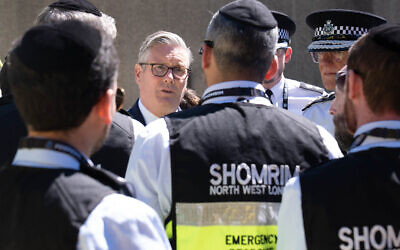
As the carcasses of four burned-out Hatzolah ambulances smouldered in the background, last month, Health Secretary Wes Streeting said: “We have to deal with this hatred at its source. We have to confront and beat the evil ideas that are permeating our society.”
Ministers took a similar line after Wednesday’s alleged attempt by a 45-year-old Somali man to stab two Jews to death in Golders Green. “We need to stamp out this growing tolerance of violence and antisemitism in our country” said Chris Ward, the Cabinet Office Parliamentary Secretary. It was “an absolute poison that we need to root out.”
Inching his cautious way towards identifying the source of that poison, the Metropolitan Police Commissioner Sir Mark Rowley named “….the Iranian state terrorist groups, extreme right and extreme left racists.”
It was left to the plainer-speaking Independent Reviewer of Terrorism Legislation Jonathan Hall KC to identify the one “interesting omission” by Rowley.
To rip this poison from its ideological roots, said Hall, would require “parts of the Muslim community “ to be “addressed. It is something of huge concern.”



This is the one source of the exponential rise in antisemitism about which ministers have had little to say about since 7 October.
Nor mainstream broadcasters, I observe, partly to avoid the world of pain for programme makers that highlighting Muslim sourced antisemitism inevitably provokes; and partly because the principal focus of broadcast media has been on the proximate cause of the rise – and understandably so: the reported 72,000 Gazan deaths and bomb damage so extensive normal life has collapsed.
The root cause of the revival of antisemitism here in the UK is the permissive environment in which the febrile politics of the Middle East have become embedded in activism and pro-Palestinian institutions here, several of them Hamas aligned, these past three decades.
As Hall also says, confronting this in all its forms means “politicians will need to step in and start basically risking a degree of unpopularity through what they say.”
And how!
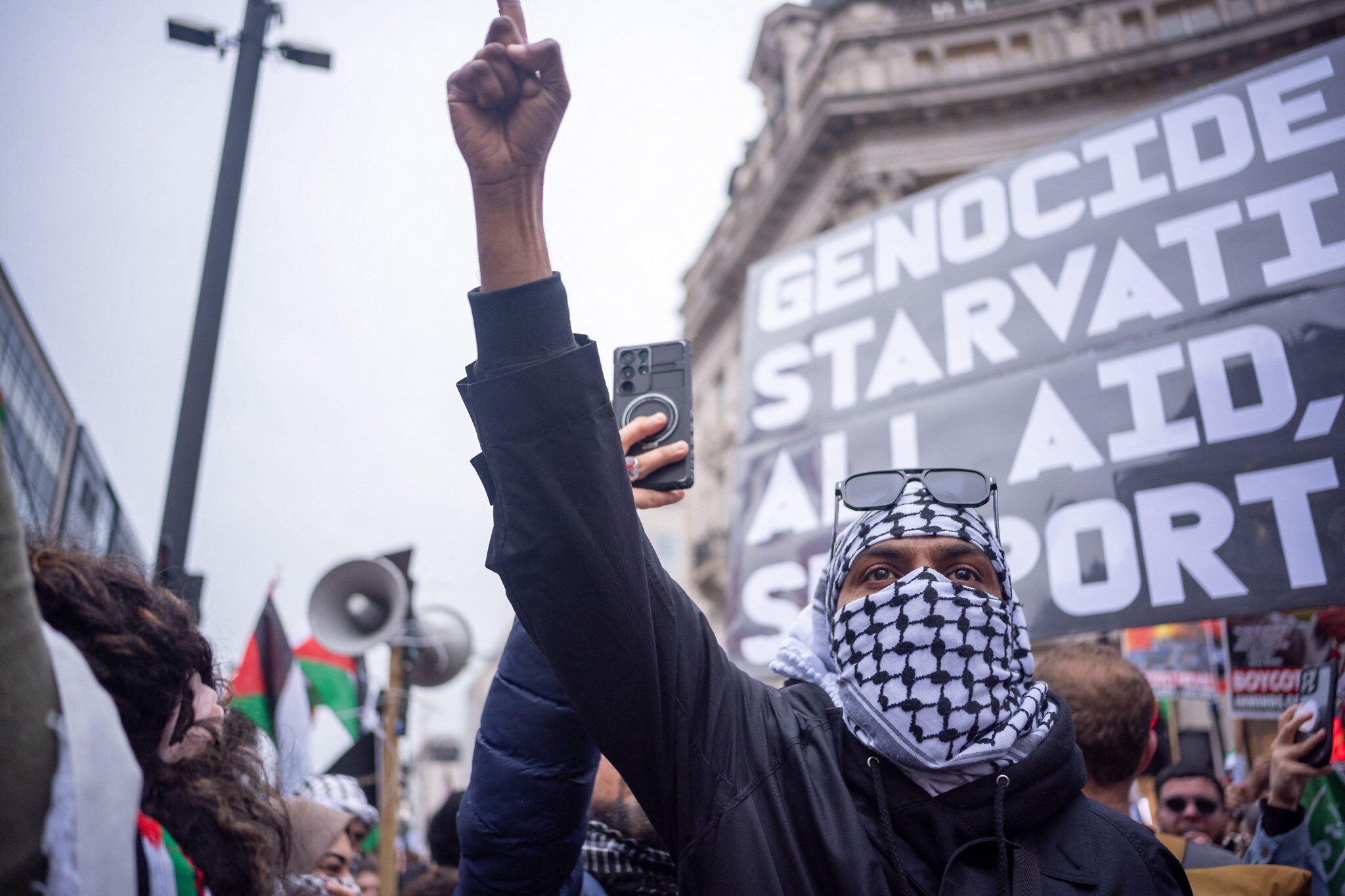
It is an article of faith to many street protesters – a fair number of whom appear to have been Muslim – that Zionism is fundamentally evil. “Zionism is a disease! Zionism is evil!” said Faris Amer into a microphone in Whitehall.
Amer is a spokesman for the Palestinian Forum in Britain, one of the six main protest march organisers typifying much of the inflammatory sloganeering.
So – it’s not just Zionism’s ultra-nationalist extreme right-wing version that’s a “disease and evil” as currently represented in the Israeli cabinet whose West Bank supporters have killed Palestinians and trashed their property with near impunity – but all versions of Zionism.
The trouble is “there are about 100 different versions” as Jon Lansman who headed Jeremy Corbyn’s 2015 Labour leadership campaign bid once joked to me. Lansman soon cooled on Corbyn as his deficiencies became apparent, particularly his ineffectual approach to Labour’s antisemitism crisis, but his point was well made.
Included in Zionism’s many manifestations are the left wing two-stater kibbutzniks whose generosity to assisting their Palestinian neighbours was repaid by being massacred, sexually abused, paraded as human trophies through the streets of Gaza City and imprisoned in Hamas’s tunnels and Palestinian households. Were these Zionists also evil and diseased?
How else should the average British Jew interpret the likes of Faris Amer’s cesspool language? Presumably that his version of Zionism covers every Jew even those whose Zionism extends no further than a basic belief in the principle of Jewish nationhood without even being a citizen of that nation?
And how else to read the menacing chants by fellow street protesters these past two and a half years: “Zionist scum off our streets!…Zionists go back home….Zionism is terrorism!….Zionism is a crime!….We hate Zionists! ….Fascist scum off our streets!…Zionists are not welcome here.All Zionists are racists… We don’t want no Zionists here….”
Or the placards: “Zionism is a parasite…The Zionist stranglehold on the media ensures only lies are published….Zionist puppet masters… Dogs of the Zionists…end the power of the Zionist lobby.”
And so on.
John Rees, co-founder of another of the main protest organisations, the hard left Stop the War Coalition, says Jewish expressions of fear that the marches have incubated antisemitism are a “generated sensation among that community.” He blames “very large parts of the media” for generating their “entirely misplaced” fears.
Rees claimed yesterday that he and his fellow protest organisers hadn’t held a demonstration since last January. So why, as I write, am I looking at their posters for demos on 7, 17, 25, 31 March, 18 April and one for next week on 7 May, and then on 16 May?
The scale of the challenge in persuading anti-Zionists to adopt less demonic language in criticising Israel is highlighted by a review of the transcripts of sermons in 80 mosques and Islamic centres across the country in the immediate aftermath of 7 October
Even the anti-Zionist Jewish Voice for Liberation (formerly Jewish Voice for Labour) seem to struggle to understand why many fellow Jews, albeit more mainstream, see themselves as “victims of an irrational prejudice that is rife among supporters of the Palestinian cause.”
The answer, of course, is that, rather unsurprisingly, the majority of British Jews take it personally when they’re told that Zionists are diseased, that they’re evil, that they’re scum, that they’re fascists and told to get “off our streets” – even though many of them have walked those streets for many more years than some of their more recently arrived accusers.
That’s because, unlike the JVL, most British Jews identify as Zionists in as much as they believe in the principle of Jewish nationhood in their ancestral home, whilst 80% disapprove (65% of them strongly) of the way Benjamin Netanyahu and the extremists in his cabinet are changing the world’s only Jewish state into an increasingly flawed democracy. Over half also think Netanyahu could have done more to provide humanitarian aid to Gazans.
Yet anti-Zionists like ex-Labour MP Chris Williamson who now broadcasts on Iranian state TV from London, see nothing “nuanced” about Zionism: “…Zionism is a Jewish supremacist ideology” he says, “It must be confronted and defeated.”
The real test has yet to come. Condemnation and warm words are the easy part. The vastly greater challenge is to lead a change in the language of anti-Zionism
Williamson simply demonstrates what polls have shown, that there is considerable misunderstanding amongst the general public about what Zionism is.
So, for British ministers to deal with the “source” of antisemitism on our streets and in parts of the NHS, universities, trade unions, and the arts and entertainment industry, they will need to be prepared to go on the offensive and to argue that much of the language of today’s evolving anti-Zionism – particularly since 7 October – does indeed masquerade as antisemitism.
However, as Hall rightly says, politically this would be extremely unpopular.
The notion that all manifestations of Zionism are intrinsically evil is deeply embedded not just in sections of the left, but even more so amongst British Muslims. “The thing is, the Zionists control everything” opined Birmingham lawyer Akhmed Yakoob recently as he campaigned to unseat Labour in next week’s local elections. Imbecilic though this comment is, since Jews make up just 0.4% of the UK population, sadly it resonates with many Muslims.
In 2019 Labour won around 80% of the Muslim vote. In the 2024 election, it fell to around 60%. Since then, Labour has further haemorrhaged Muslim support to the Green Party whose local election candidates have been making increasingly inflammatory comments about Zionism.
Indeed, two Lambeth council candidates in their 50s, Saiqa Ali and Sabine Mairey have been arrested for alleged posting antisemitic comments on social media.
The scale of the challenge in persuading anti-Zionists to adopt less demonic language in criticising Israel is highlighted by a review of the transcripts of sermons in 80 mosques and Islamic centres across the country in the immediate aftermath of 7 October.
Six days after the attack, Abdur Rashid Holmes from Nottingham cited the same passage as written in Hamas charter: “The Jews will fight you and you will prevail over them. Then a rock will say ‘Oh Muslim, here is a Jew behind me. Kill him.”
In none of the 80 speeches was there any criticism of Hamas’s genocidal attack on unarmed Israelis. Ajmal Masroor, of Palmers Green Mosque, in north London came closest – but stopped short: “I am not going to condemn Hamas for its assault on Israel because those that want me to condemn Hamas want me to take sides, to be taking the side of Israel…”
From pulpit after pulpit, the focus was entirely on Israel’s response.
Most Imams led prayers for the mujahideen (without directly naming Hamas), some making derogatory references to Jews:“…Pray for the victory of the mujahideen fighting the enemy of Allah and Islam in Israel. Protect them from the usurping Jews, oh Almighty, take them away.”

When not specifically referencing Jews, there were inflammatory tirades about “the Zionists” in overtly racist language: “All of this is happening at the hands of the usurping Jews, the unjust haters, the monkeys and pigs. Palestinians fighting the Jews are “striving to preserve the pride of the Muslims”, for the “word of God. To make the word of the Zionists the lowest.”
My wife is Jewish. I rarely go to synagogue with her, but she and our friends who do go tell me they have never heard a derogatory comment about Muslims or even Islam in any service across the spectrum from Reform to ultra-Orthodox synagogues. By contrast, her Muslim taxi driver who took her to the airport the other day commented that while his imam was very proper, he was aware of other imams in London mosques who had made bigoted comments about Jews and this unsettled him.
I shared the transcripts of the 80 sermons with a senior KC specialising in the law covering terrorism and incitement. He said some of them amounted to stirring up racial hatred; some also expressed support for Hamas “in a way that encourages other people to support Hamas.”
So, quite apart from the law, there’s a particular onus on influential Muslim leaders to try to persuade anti–Zionists to adopt a different form of language in criticising Israel.
It’s perfectly possible to do that without pulling punches and without resorting to incendiary language that risks inciting those predisposed to violence.
As Justin Cohen of this parish reported hours after the Golders Green attack, there are encouraging signs from some of our most senior Muslim clerics. Their condemnation statements were powerful and heartfelt.
Likewise, the Home Secretary Shabana Mahmood who has in the past been very critical of Israel. But was she now “ready to say something that might be quite uncomfortable to members of your own party” she was asked by Nick Robinson on the Today programme. “I do recognise the need for more voices” she said.
Still, the real test has yet to come. Condemnation and warm words are the easy part. The vastly greater challenge is to lead a change in the language of anti-Zionism – particularly when accusations of anti-Zionism morphing into antisemitism are usually met with indignant “how-very-dare you” fulminations.
And yet, since 7 October – in far too many cases on British streets and in institutions – there has been no meaningful difference.

Keep community journalism free.
Jewish News is free for everyone. No paywall. No barriers. Just trusted journalism for anyone who wants to stay connected to Jewish life in Britain.
If you value that, please support us.
From as little as £5 a month, you can help keep our journalism free and accessible to all.
Every day, we report on the issues that matter to our community. We celebrate achievements, support charities, challenge antisemitism and ensure Jewish voices are heard more widely.
From as little as £5 a month, you can help us continue to:
- Report on the stories shaping Jewish life in the UK and beyond
- Bring our community together through shared stories, events and campaigns
- Celebrate the people, culture and moments that define our community
- Support organisations doing vital work across Jewish Britain
You can make a one-off donation or become a regular supporter. Every contribution helps keep our journalism free, independent and accessible to all.
If everyone who values Jewish News gave a small amount, it would make a real difference to our future.