Prefer Jewish News on Google

The world was outraged by Gaza. So why doesn’t it care about Sudan?
Sudan’s horror is plain to see. The hypocrisy and indifference is harder to watch
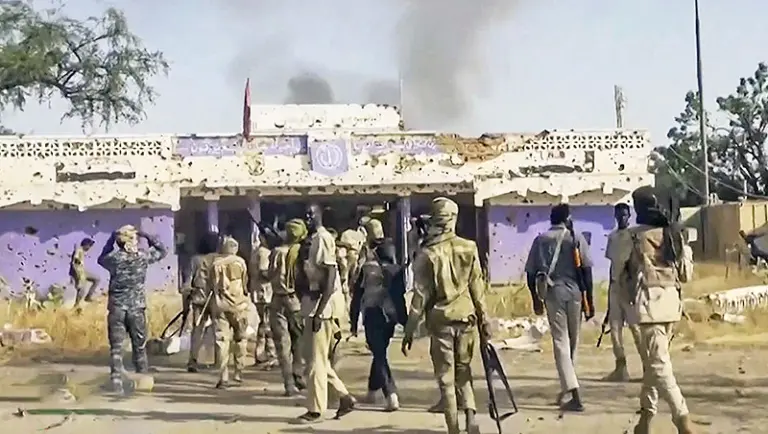
You can see the blood from space. That’s how bad the slaughter has now become in Sudan. In one maternity hospital, around 500 people – nurses as well as patients – were executed recently, according to the World Health Organisation. Newborns have been massacred. Some quarter of a million civilians are still trapped in El-Fasher, which has now fallen after an 18 months siege. Children are starving. Children have been raped. The world has done next to nothing.
In the 31-month war between the Sudanese Armed Forces (SAF) and the Rapid Support Forces (RSF), over 11m people have been displaced. Some 4m have fled the country as refugees. The UN estimates 30m are in need of humanitarian aid. Tens of thousands of civilians have died, though exact numbers are hard to pin down. The United Arab Emirates is widely thought to be supplying weapons to the RSF, an Arab militia and successor to the Janjaweed who perpetrated a genocide in Darfur 20 years ago. (It denies the charge.)
The current war in Sudan began in April 2023, a few months before October 7. To note that it has received significantly less coverage than events in Gaza doesn’t even begin to capture the scale of global indifference. In the nine months following October 7, according to a study by the London School of Economics, mainstream outlets in Britain published 18 times as many stories about Gaza than about Sudan.
Why is the disparity quite so vast? The answer to this brings us to a deeper question: why is the world quite so obsessed with Israel and Palestine?
First, let me make something clear. My intention here is not to instrumentalise appalling events in Sudan merely to score a cheap hasbara point on behalf of Israel. The purpose of this column is to understand a little more about the way we cover and don’t cover these conflicts, because I think the answers are useful and revealing.



So why the disparity? The easy answer is antisemitism. The world is disturbingly obsessed with the Jewish state and its crimes. The world finds the Jews to be uniquely evil. It is fed up with feeling guilty about the Holocaust and is interested in the Palestinian cause primarily because it gives people permission to hate Jews again, an atavistic cultural reflex that defies permanent suppression.
Is that an answer? Yes, it is an answer. It was ever thus. But there are many other answers. Antisemitism alone doesn’t suffice.
Other factors include the nature and limitations of modern media. Few British media outlets regularly report on Africa at all nowadays, as foreign reporting budgets have cratered over the past 15 years. Mainly this contraction is due to shrinking advertising revenue, though I think Britain’s growing introversion as a country has also played a role.
The sad truth is that reader interest in African stories is very low; whereas in Israel and Gaza it is high. Data analysis allows media outlets to count these views and clicks very carefully — and take them into account when deciding whether to commission expensive foreign assignments.
Both Sudan and Gaza are seriously dangerous places to report from (and of course international media has been mostly banned from the latter), but as Matti Friedman noted in his famous 2014 essay on reporting in the Middle East, Israel is an easy and mostly safe place to cover, and to criticise.
So much for the media. The deeper, more depressing reality is that most people in Britain or Ireland or America just don’t hugely care about what happens in Sudan, much as they didn’t hugely care about Ethiopia’s Tigray war in 2020 or the ongoing Yemeni civil war, both of which have claimed as many or likely far more lives than the recent conflict in Gaza.
Partly this is because these other conflicts seem distant and awareness levels are extremely low. Despite Britain’s imperial legacy in Sudan, few of us could locate the country on a map. Its history is almost blank to us.
In Sudan, there is no clear complicity from the British or indeed American government, which do of course coordinate deeply with Israel on security and sell it weapons. Nor is there quite the same gaping disparity in power and weaponry that exists between the IDF and Hamas. If you dislike your government and like an underdog, the conflict in Sudan has little to offer you.
And, of course, none of the people killing each other in Sudan are white.
This is an essential point. I once asked the Channel 4 newsreader John Snow, a critic of Israel, why the Middle Eastern conflict interested him so particularly. His answer was revealing. “One of the reasons there is an obsession,” he told me, “is because people like us are engaged in this.
By that I mean, I’m almost making a racial observation, not about Judaism, but about Europeans and Americans, white people in fact, and the conflict feels horribly like our own conflicts from our own colonial pasts.”
People like us.
British audiences have very little emotional or moral investment in Sudan, but Israel and Palestine is another matter entirely. The Arab-Jewish war over Palestine has been going on for more than a century, really since it became a British mandate. And the story of Israel is woven far deeper into the foundations of Christian civilisation: Bethlehem, Nazareth, Jerusalem, these sacred names exist in the substrate of our culture. “The Holy Land does not just haunt our imaginings, it shapes them,” wrote the historian Tom Holland in a Christmas essay for The Sunday Times back in 2023. “That we hold the ideals, the assumptions and the prejudices that we do is due in huge part to stories that originated there.”
Many British Muslims also invest huge amounts of emotion, pride and moral fervour into the Palestinian cause. This outrage is sincere and derives partly from religious and ethnic solidarity, and partly from the holy significance of Al-Quds. But it also reflects a sense of humiliation, of anger and frustration at their own government being an ally of Israel’s, and a wider desire for greater political recognition and influence. This Gaza war has been an awakening for British Muslims that will reverberate far beyond the issue of Palestine.
In their focus on Palestine, British Muslims often find common cause with the left and far left, for whom this conflict has long been a moral playground, not so much a real country as a screen upon which narratives of colonialism and white European fallibility can be projected, and emotional satisfaction reflected back.
Throw in the Jewish connection to Israel too and you have all the necessary ingredients for the banquet of anguished discourse that has played out on social media over the past two years, in which algorithms have boosted content from Gaza because it provokes such fierce engagement. The constant presence of appalling images on smartphone screens has been a central animating force behind the scale and ferocity of the Gaza protest movement. For Sudan, not so much.
Given what’s happening in El-Fasher, leftist protesters would in theory have perfectly good cause to gather in their thousands outside the UAE embassy in London and Paris, to protest its alleged involvement in Sudan and demand Britain stop selling weapons to the Gulf state. Millions could use their platforms to ramp up demands that more is done in Sudan. But for all the reasons stated above, they won’t.
These are glaring double standards, but many supporters of Israel are also too quick to use them as a get out jail free card. Just because people are obsessed with Israel’s wrongdoings, this doesn’t somehow validate all that has happened. Just because they hurl exaggerated calumnies about widespread famine, this doesn’t mean it was right to shut off aid into Gaza and exacerbate acute hunger issues. It’s not enough to just say “what about Sudan?”. The destructive intensity of the Gaza war was genuinely terrifying. Being less brutal than the Janjaweed is too low a bar.
As ever with the Middle East, the challenge here is to hold many truths in your head at once and avoid easy answers. It is certainly the case that prejudice, proximity, activist narcissism and long history all serve to motivate an obsessional focus on Israel and Palestine. This focus warps the conflict itself, as Hamas often acts in order to weaponise global outrage. Journalistic and indeed epistemic standards have dissolved in the emotional cauldron of Gaza.
The sad but undeniable truth is that while Israel and Palestine are a global obsession, few in Britain will ever care about Sudan or other conflicts in Africa and the Middle East. This is a source of frustration, but it is also an immovable reality. It is the nature of the bizarre global battlefield that that Jewish state finds itself on. And as the old footballing cliche goes, you can only beat what’s in front of you.
The challenge is to somehow to acknowledge this inequality and what it represents, but also not use it as an excuse. Sudan is a tragedy on its own terms, not an appendage of the meta-war around Gaza. Israel and Palestine is a unique conflict upon which much of the world projects its own emotions and frustrations. This is unlikely to change, so instead it must be navigated.

Keep community journalism free.
Jewish News is free for everyone. No paywall. No barriers. Just trusted journalism for anyone who wants to stay connected to Jewish life in Britain.
If you value that, please support us.
From as little as £5 a month, you can help keep our journalism free and accessible to all.
Every day, we report on the issues that matter to our community. We celebrate achievements, support charities, challenge antisemitism and ensure Jewish voices are heard more widely.
From as little as £5 a month, you can help us continue to:
- Report on the stories shaping Jewish life in the UK and beyond
- Bring our community together through shared stories, events and campaigns
- Celebrate the people, culture and moments that define our community
- Support organisations doing vital work across Jewish Britain
You can make a one-off donation or become a regular supporter. Every contribution helps keep our journalism free, independent and accessible to all.
If everyone who values Jewish News gave a small amount, it would make a real difference to our future.