Prefer Jewish News on Google

To bring down Netanyahu for good, opposition parties must consider the unthinkable
There are two issues which can be seen as existential threats to Israel's continued existence - but only one has the potential to destroy the country in the next decade

Some 36 years ago, Israeli politics came close to its greatest upheaval since the 1977 election when the country’s Labor Party lost its decades-long dominance.
In 1990, the Likud Party, led by Yitzchak Shamir, was in an uneasy governing coalition – a “national unity government”, with Labor, led by Shimon Peres. Disagreement came – then as now, over the issue of the West Bank, and the Palestinians. Peres secretly negotiated with Charedi parties to support a motion to dissolve the government and then form a new coalition together.
The move became known as HaTargil HaMasriach – The Dirty Trick – due to perceived duplicitous dealing by Peres. While the Labor leader succeeded in bringing down the administration, his attempt to form a new government in coalition with the Charedim ultimately failed, as the firebrand religious authorities behind the strictly-orthodox political groups railed against any alliance with “the eaters of hares and pigs”.
With all that was to follow – Oslo, Rabin’s assassination, the Second Intifada – The Dirty Trick became little more than a footnote in Israeli political history.
Much has changed since then. For one thing, less than a decade later, Charedi parties did enter a governing coalition with the left (although one party exited just two months later due to a disagreement regarding Shabbat transportation). For another, the Israeli left is now a shadow of its former self, while the Charedi political presence has grown stronger.


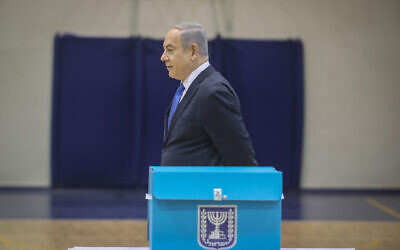
Next month there will be another election in Israel. And despite everything – the disaster of Israel’s lack of preparedness in the face of 7 October, ongoing corruption trials, the Qatargate revelations – current polling suggests that there is still a chance that Benjamin Netanyahu may be able to recreate a coalition similar to the one he has maintained for the last four years.
Netanyahu is the most successful politician in Israel’s history. He has led the country for more than a quarter of the period since its declaration in 1948. He has been in politics so long that two of his key political opponents have previously served as his chiefs of staff. He is somehow continuing to weather scandals that would have brought down almost anyone else long since.
Current polling suggests that there is still a chance that Benjamin Netanyahu may be able to recreate a coalition similar to the one he has maintained for the last four years
Given all this, you would assume that those opposed to him would have been working on a plan of how to beat him. But there is no real indication that this has been happening. And the most likely reason for that is because those who oppose Netanyahu do not want to face reality.
That reality is simple. The electoral mathematics shows that the only way that an anti-Netanyahu coalition, even one which includes the Arab Ra’am party, can be certain of bringing down their bête noire – not just temporarily, but to such a point where his grip on the Likud Party itself weakens and a dozen ambitious lieutenants start squabbling over the pieces – is to do a deal with the Charedim. This would inevitably involve an agreement to withdraw the proposed compulsory draft for young men in yeshiva.
The reason people do not want to face that reality is because it is profoundly unpopular. The knowledge that Charedim do not have to do the army service which is compulsory for others has long rankled – both with secular Israelis and increasingly with religious Zionists, many of whom consider it a sacred duty to serve. Additionally, there are understandable concerns about the grip on religious authority exercised by the Orthodox rabbinate in Israel – whether with regards to marriage, Shabbat observance or basic rights of Progressive Jews to practice Judaism as they see fit.
Those who hold such perfectly reasonable concerns and grievances will have to decide whether they are outweighed by the alternative – which is another Netanyahu coalition, with both the Charedim and the far-right parties of Smotrich and Ben Gvir. That means a renewed – and probably successful – attempt to strip the Supreme Court of its powers. It certainly means no state commission of inquiry into the catastrophic failures which enabled Hamas to carry out mass murder on 7 October 2023.
It means a repeated attempt to annex the West Bank, which, as world opinion over the last few months has shown, will effectively be a fast-track to assuring Israel reaches world pariah status.
It means a continuation of the grotesque situation where the man leading the successor party to Meir Kahane’s “Kach” continues to serve as a senior minister in the Israeli government. It means that Netanyahu will continue to insert his allies into positions from which they can tamper with the mechanics of the state – yesterday’s decision by the electoral commission to try and ban Arab parties from standing together is only the latest affront to democracy.
Politics is full of unenviable choices – this one is no different.
There is doubtless a temptation to gesture at the most recent difficulties to have beset the Netanyahu coalition – inter-party squabbles, for instance – and cite this as proof that that all anti-Netanyahu parties need to do is wait, and the current rickety coalition – even if it is revived after the election – will sooner or later collapse under its own weight.
That is a misguided assumption, for two reasons. The first is that Netanyahu is the prince of prevarication. One of his key talents as a politician is endlessly stretching out a process, in the hope that his opponents splinter or exit the scene before he does. A number of the parties which oppose Netanyahu are themselves centre-right, and among them are politicians who are deeply divided on the wisdom of including Mansour Abbas’s Ra’am party in a governing coalition. All Netanyahu needs to do is have his allies cajole, convince, or even simply bully certain vulnerable individual MKs, and a government hostile to him collapses. That’s exactly what happened in 2022.
Second, unless anti-Netanyahu parties offer the Charedim an alternative, they will continue to support him, even if it comes in the form of a supply and demand-type deal. Look at it for a second from a Charedi perspective. If their choice is between a Netanyahu coalition where there is at least token willingness to listen to their concerns, or an anti-Netanyahu coalition where there is little but contempt for their positions, it doesn’t take a genius to work out which side they will ultimately opt for.
All Netanyahu needs to do is have his allies cajole, convince, or even simply bully certain vulnerable individual MKs, and a government hostile to him collapses. That’s exactly what happened in 2022
At the end of the day, Israel faces two significant challenges from the 74% of its population which are Jewish. The first is the rise of an explicitly ethno-nationalist far right. The second is the exponential growth of a Charedi sector that largely refuses to serve in the IDF and which only pays 4% of the country’s tax revenue despite now making up more than 14% of the population . Both of these challenges may be existential to the State – but only one has the potential to destroy Israel within the next decade. Eisenkot, Bennett, Lapid, Golan and Lieberman can face that reality or ignore it.
I sympathise with those who view this column’s suggestion with concern. I also understand those who will respond by saying that a choice between a xenophobocracy, to coin a term, and a theocracy is a devil’s alternative.
But dislike it or absolutely loathe it, that is the choice faced by those politicians who oppose Netanyahu. They will have to decide whether offering the Charedim an alternative is worth bringing Netanyahu down for good or not.
If they do decide to commit to the former, they cannot be sure that a future generation of Israelis won’t ultimately describe that attempt as another “Dirty Trick”.
But if politics was about making easy choices, the stakes would be far lower.

Keep community journalism free.
Jewish News is free for everyone. No paywall. No barriers. Just trusted journalism for anyone who wants to stay connected to Jewish life in Britain.
If you value that, please support us.
From as little as £5 a month, you can help keep our journalism free and accessible to all.
Every day, we report on the issues that matter to our community. We celebrate achievements, support charities, challenge antisemitism and ensure Jewish voices are heard more widely.
From as little as £5 a month, you can help us continue to:
- Report on the stories shaping Jewish life in the UK and beyond
- Bring our community together through shared stories, events and campaigns
- Celebrate the people, culture and moments that define our community
- Support organisations doing vital work across Jewish Britain
You can make a one-off donation or become a regular supporter. Every contribution helps keep our journalism free, independent and accessible to all.
If everyone who values Jewish News gave a small amount, it would make a real difference to our future.