Prefer Jewish News on Google

Why Human Rights Day is a Jewish call to action – not just a date in the calendar
Marking 77 years of the Universal Declaration, Mia Hasenson-Gross urges British Jews to defend the human rights legacy shaped by our own history
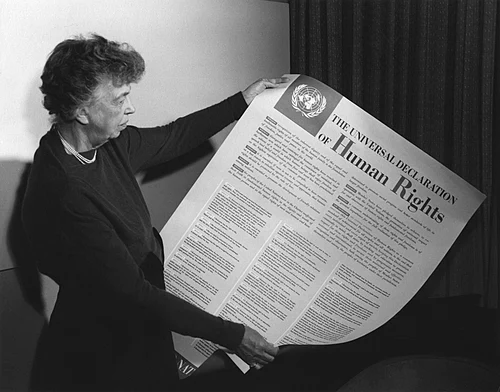
On 10 December, we mark International Human Rights Day and the 77th anniversary of the Universal Declaration of Human Rights – a document that transformed the world’s moral and legal landscape and stands as a legacy of dignity and accountability. For us at René Cassin, the Jewish voice for human rights, this day is more than a commemoration; it is a call to honour that legacy by turning memory into action, ensuring the principles born from tragedy continue to protect dignity today.
The Holocaust was not only a tragedy to be remembered – it was an ethical wake-up call. Ninety years ago, the Nuremberg Laws institutionalised antisemitism, stripping Jews of rights and legitimising discrimination and violence. These laws thrived in a void – a world without agreed principles requiring nations to protect the basic dignity of those they governed. It took the enormity of the Holocaust to catalyse a global reckoning with the consequences of legalised hate.
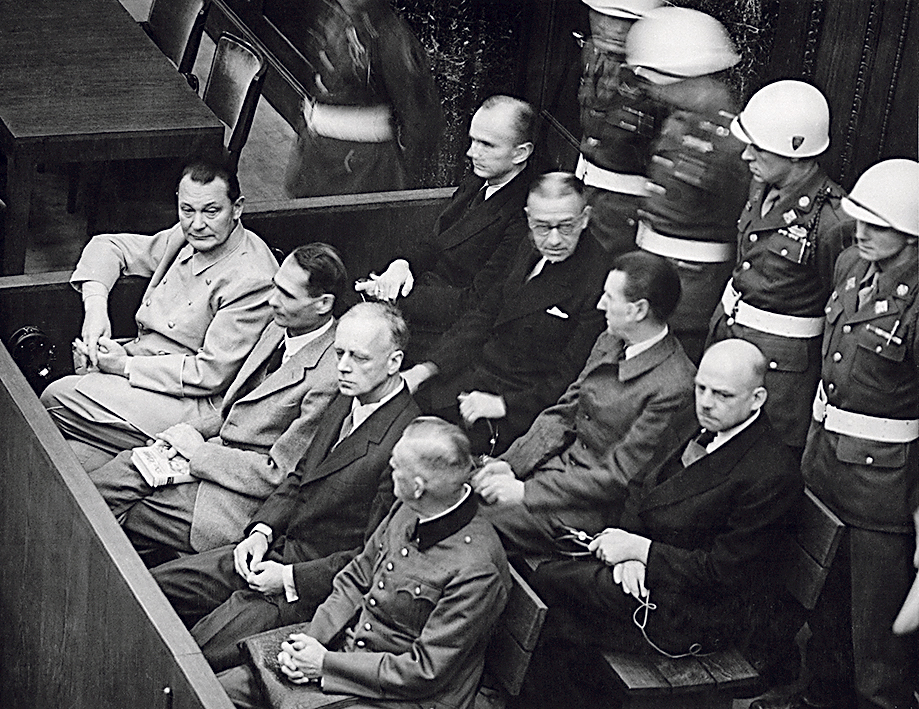
That reckoning began with the Nuremberg Trials (1945–46), where leading architects of Nazi terror were prosecuted. These trials introduced concepts that now underpin international law: crimes against humanity, genocide, and aggression. They marked what we call the “Nuremberg Moment”—the birth of the modern human rights framework. For the first time, individual perpetrators were held accountable for violating the inherent rights of others.
Jewish legal minds shaped this framework. Hersch Lauterpacht championed “crimes against humanity”, placing individual rights at the heart of international law. Raphael Lemkin coined the term “genocide” and led the campaign for the Genocide Convention. And Monsieur René Cassin, our namesake, helped draft the Universal Declaration of Human Rights (1948), working alongside Eleanor Roosevelt to articulate a vision of dignity for “all members of the human family”.
The Universal Declaration: A living promise


Adopted on 10 December 1948, the Declaration proclaimed that every person has “inherent dignity” and “equal and inalienable rights.” It was a direct response to the dehumanisation of the Holocaust – a statement that every life lost in Auschwitz mattered more than the regime that killed them. This document became the foundation for countless treaties and mechanisms: the Genocide Convention, the European Convention on Human Rights, and our own Human Rights Act.
Yet in today’s discourse, human rights are often treated as neutral, or even hostile, and their origin story is forgotten. We see echoes of the marginalisation and hostility that preceded 1945 in the erosion of protections for refugees, in attacks on frameworks like the European Convention on Human Rights, and in struggles for access to healthcare, housing, and food as basic rights.
This matters because when we strip away that origin, human rights lose their legitimacy and urgency. They are not optional; they are critical. As recently reiterated by Professor Francesca
Klug, “The entire post-war international human rights architecture is hanging in the balance…” And she went as far as warning that by threatening to leave the European Convention on Human Rights, the UK will be “joining a club with Belarus and Russia”.
A Jewish legacy of responsibility
For the Jewish people, this is more than history; it is a mandate. The Holocaust gave us memory but also responsibility: to protect dignity, demand accountability, and act when others are persecuted. Our faith and traditions teach us to stand in solidarity with the vulnerable, to speak as “experts by experience”, and to draw moral authority from historical memory.
When we call for safe routes for refugees, we remember the Evian Conference and the ships turned away. When we challenge hate crimes, we recall how antisemitism metastasised into persecution. When we campaign for socio-economic rights, we affirm that they are indispensable for a life of dignity.

Monsieur René Cassin always believed that human rights were not only a legal framework but also a moral imperative rooted in Jewish tradition:
“Human rights are an integral part of the faith and tradition of Judaism. The belief that man was created in the divine image, that the human family is one, and that every person is obliged to deal justly with every other person are basic sources of the Jewish commitment to human rights.” (Monsieur René Cassin, 1974)
Human Rights Day is not just about reflection – it is about action. Learn the origin story of human rights and share it. Support René Cassin and other organisations that defend dignity and equality. Challenge narratives that undermine these protections. Advocate for policies that uphold the promise of the Universal Declaration.
Mark International Human Rights Day (10 December) and join us this Friday for Human Rights Shabbat (12–13 December). Explore how Jewish legacy calls us to act today. Together, let us honour 77 years of the Universal Declaration of Human Rights and reflect on what it means to turn legacy into living responsibility.
Because the Declaration is not just a document – it is a living promise. A promise of dignity, not hate; hope, not fear. As members of the Jewish community, this is our legacy—a legacy that carries a unique responsibility. Our history shaped the human rights framework. Now, we must ensure it shapes the future.
- Mia Hasenson-Gross is the Executive Director of René Cassin, the Jewish voice for human rights in the UK.

Keep community journalism free.
Jewish News is free for everyone. No paywall. No barriers. Just trusted journalism for anyone who wants to stay connected to Jewish life in Britain.
If you value that, please support us.
From as little as £5 a month, you can help keep our journalism free and accessible to all.
Every day, we report on the issues that matter to our community. We celebrate achievements, support charities, challenge antisemitism and ensure Jewish voices are heard more widely.
From as little as £5 a month, you can help us continue to:
- Report on the stories shaping Jewish life in the UK and beyond
- Bring our community together through shared stories, events and campaigns
- Celebrate the people, culture and moments that define our community
- Support organisations doing vital work across Jewish Britain
You can make a one-off donation or become a regular supporter. Every contribution helps keep our journalism free, independent and accessible to all.
If everyone who values Jewish News gave a small amount, it would make a real difference to our future.