Prefer Jewish News on Google
The women behind history’s greatest war crimes trial
Author Natalie Livingstone speaks at JW3 about her new book, highlighting eight extraordinary females erased from the Nuremberg Trials
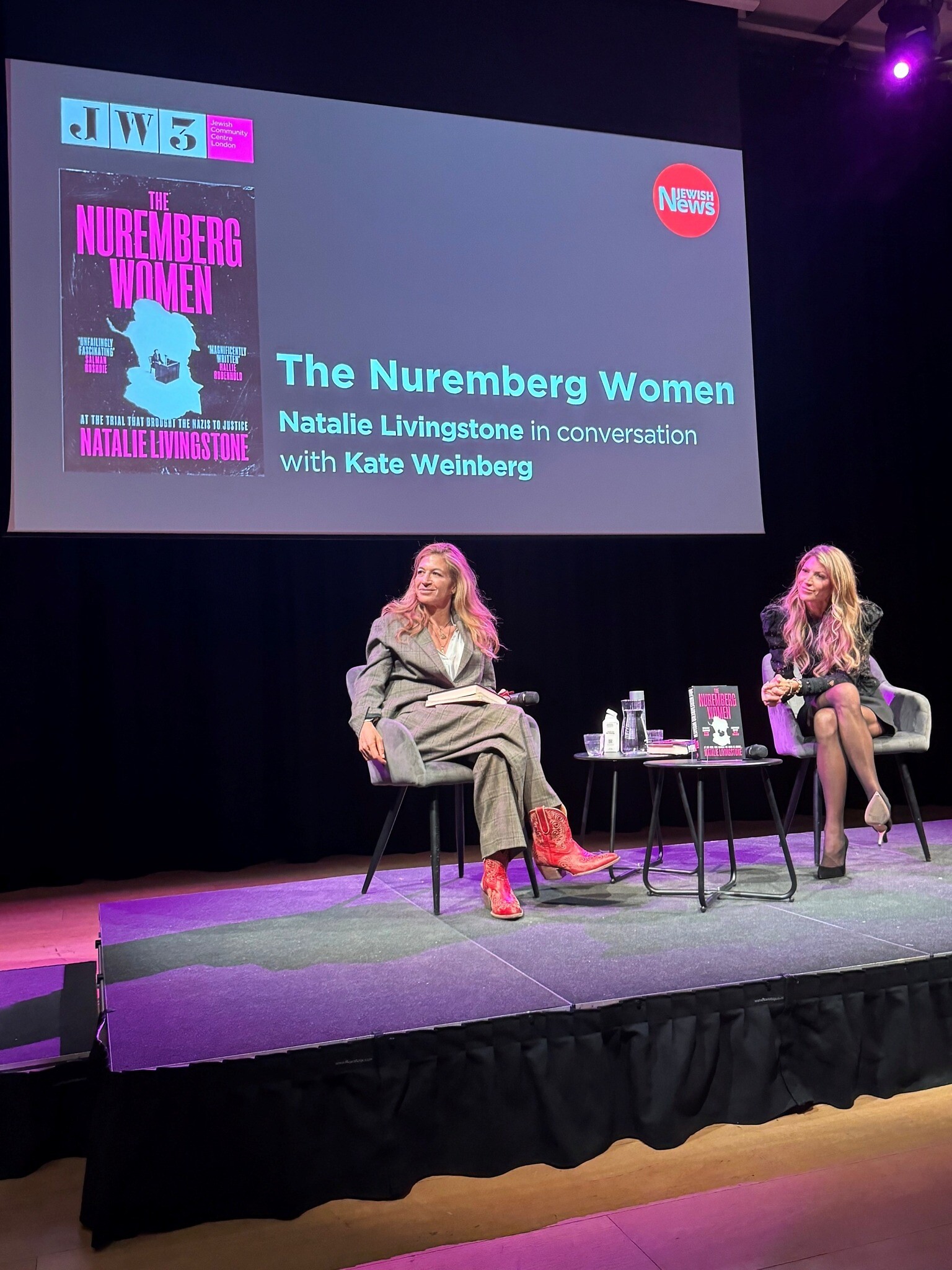
Historian and writer Natalie Livingstone’s powerful new book The Nuremberg Women is the story of the women connected to the Nuremberg Trials, and highlights how history has largely erased female voices from this highly significant legal reckoning.
With its sexy black and shocking pink cover, the book is as elegant looking as its author, who wore black lace to address an audience of 200 men and women at JW3 on Tuesday evening, at an event held in conjunction with Jewish News.
In conversation with fellow writer Kate Weinberg, Natalie criticised the recent film Nuremberg, whose promotional poster features “just men… all men in a row,” despite the crucial role women played behind the scenes and within the courtroom itself. Natalie described watching the film as both emotional and deeply frustrating. “There were only three women in Nuremberg (the film),” she noted, and even those characters were largely unnamed or reduced to stereotypes. “I was happy and relieved, on behalf of these women, that at least somewhere their story would be told.”
Those who were in the film were misrepresented, and none more so, says Natalie, than Emmy Goering, wife of Nazi leader Hermann Goering. In the film, Emmy is portrayed as glamorous and seductive, yet Natalie says in reality “she was a wicked, wicked woman… perfectly aware of the minutiae of the Final Solution”.
The heart of The Nuremberg Women lies in restoring the names and stories of extraordinary women whose contributions have faded into obscurity. “The importance of remembering names,” she explained, became one of the central themes of her research.

Among the most compelling figures is Marie-Claude Vaillant-Couturier, the French resistance fighter and Auschwitz survivor featured on the book’s cover. Arrested in 1942 for her resistance work, she survived Auschwitz and Ravensbrück before delivering a landmark testimony at Nuremberg in January 1946. Natalie described her two-hour testimony as “one of the greatest pieces of oratory in modern history”.
Vaillant-Couturier gave the courtroom its first detailed verbal account of the horrors of Auschwitz, carefully naming victims and restoring individuality to those reduced by the Nazis to numbers. After testifying, she walked directly past the Nazi defendants and stared them in the eyes. In that moment, Natalie said, “she felt she was representing all the people she lost in the concentration camps”.
It was the painting Courtroom 600 by British artist Laura Knight, on permanent display at the Imperial War Museum, that inspired Natalie to write the book. “I suggest anyone who hasn’t seen it (the painting) should go and spend some time looking at it. It is a sea of men, male judges, male defendants, male soldiers – as Rebecca West, who is one of the women in this book, says it’s a man’s world.”
Knight’s diaries became central to Natalie’s research. At 68 years old, Knight flew for the first time to Nuremberg, describing the excitement of air travel with “childlike wonder.” Yet Natalie was startled by one chilling detail: after discovering she had been assigned Hitler’s former hotel room, Knight wrote, “I’ve never had a more sound night’s sleep.”
“That really stopped me in my tracks,” Natalie admitted, fascinated by the “moral complexity” of a woman capable of such empathy towards the destruction she discovered in Nuremberg following years of bombing yet such ease in Hitler’s former surroundings.
As part of her research Natalie too went to Nuremberg and stayed in the same hotel. “But it was impossible to sleep in this city of these ghosts. It was also weird that in the hotel literature there was no acknowledgement of the part that Nuremberg played in Nazism. Nuremberg is the cradle of Nazism. In 1935 the Nuremberg laws were promulgated in Nuremberg itself, the home of the Nuremberg rallies. It’s no small accident that the time of reckoning for Nazi crimes was in Nuremberg itself. It is a city steeped in ghosts and in evil. One can almost feel the very worst of humanity coming at you.”
The book also uncovers the remarkable story of Hungarian aristocrat Ingeborg Kalnoky. Once a glamorous countess, Kalnoky fled Nazi-occupied Hungary while pregnant, travelling across war-torn Europe with three children. Eventually, she became hostess of the “Witness House” in Nuremberg, where Holocaust survivors and Nazi witnesses stayed under the same roof. One evening, Hitler’s official photographer Heinrich Hoffmann confronted concentration camp survivors at the dinner table, dismissing Nazi crimes while survivors showed photographs of murdered family members.
Despite the darkness of the subject matter, the discussion also highlighted moments of humanity and absurdity. Natalie recounted how the bikini reportedly made its debut at a Nuremberg pool party hosted by American judge Francis Biddle, whose romance with writer Rebecca West led him to write flirtatious notes “from the bench” during the trials.
For Natalie, whose Hungarian grandparents survived the Holocaust, the project became deeply personal. “Nuremberg always loomed very large in my life. My uncle (Robert Rainer) was the first Jewish baby born in his town. He was an eminent criminologist, and the penny only dropped recently; this is why he became a criminologist, because he wanted to try and decipher the crimes that had been visited on his parents and on the whole of the Jewish people.”
Natalie said that as a Jewish woman it was “overwhelming writing about international justice at a time when the system is being tested to its very maximum, and we’re experiencing a climate in which the kind of simmering hatred that resulted in the crimes of Nuremberg incubated. So it’s scary, but it’s also very hopeful, because when I read the stories of these eight women, when I look at their resilience and I look at their joie de vivre, and I look at their sense of humour, and I look at their ability to see hope in the darkness, and love and search for passion where there is nothing, and search for truth in a field of misinformation, that gives me hope that we can get out of the bleakest of periods. There are women who have been able to do this; we can do it again.”
Researching these women left Natalie inspired. “None of these women were in positions of power,” she concluded, “but it didn’t mean they weren’t powerful.”
Click here to read our interview with Natalie Livingstone about her book.

Keep community journalism free.
Jewish News is free for everyone. No paywall. No barriers. Just trusted journalism for anyone who wants to stay connected to Jewish life in Britain.
If you value that, please support us.
From as little as £5 a month, you can help keep our journalism free and accessible to all.
Every day, we report on the issues that matter to our community. We celebrate achievements, support charities, challenge antisemitism and ensure Jewish voices are heard more widely.
From as little as £5 a month, you can help us continue to:
- Report on the stories shaping Jewish life in the UK and beyond
- Bring our community together through shared stories, events and campaigns
- Celebrate the people, culture and moments that define our community
- Support organisations doing vital work across Jewish Britain
You can make a one-off donation or become a regular supporter. Every contribution helps keep our journalism free, independent and accessible to all.
If everyone who values Jewish News gave a small amount, it would make a real difference to our future.