Prefer Jewish News on Google
Trial of Irish pro-Palestine activist in Germany not a show trial – Merz
Merz insists Germany’s courts meet international legal standards as Irish politicians raise concerns over activist Daniel Tatlow Devally’s trial
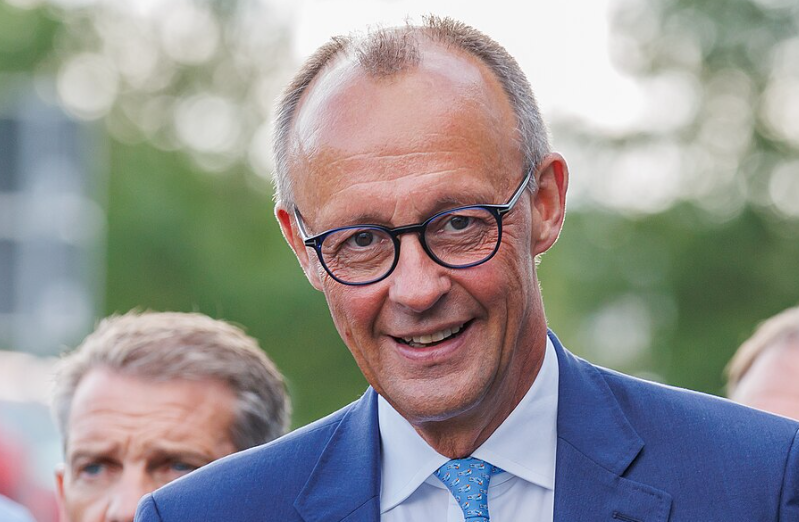
German Chancellor Friedrich Merz has denied that the trial of an Irish Palestine protester is a show trial and stressed that Germany’s judiciary is independent.
Mr Merz was asked about the case ahead of a meeting in Dublin with Irish premier Micheál Martin.
The visit is part of Ireland’s six-month presidency of the Council of the EU.
Daniel Tatlow Devally, 32, from Dublin, is one of five people on trial in Germany charged with criminal damage against Elbit Systems, a firm that supplies weapons systems to the Israeli Defence Forces (IDF).
A cross-party delegation of Irish politicians attended a hearing in his trial in Stuttgart last week, where they raised concerns about the “incredibly harsh” conditions he was being kept in and the legal process – in particular that no recording or transcription of the trial is being kept.


Both an opposition and a government politician, TDs Richard Boyd Barrett and Barry Ward respectively, have compared it to a “show trial”.
At a press conference at Farmleigh House in Dublin on Tuesday, Mr Merz was asked about the accusations of a “show trial”.
“I want to comment on that very simply, to say we have a judicial process in Germany, consular assistance is being provided,” he said.
“The accused are being provided with a legal defence team and I have absolutely no doubt that regardless of any nationality, judicial processes in Germany are conducted according to internationally valid standards.
“There is no doubt about that.
“The German justice system is independent and is also obliged to follow legal standards, and there is no doubt that cases are handled according to those standards in Germany, regardless of the nationality of the accused.”
Mr Martin said the Government does not comment on “live” cases but said consular assistance had been offered to the Irishman and his family.
He said: “There’s been up to six visits to Daniel Tatlow Devally and a dedicated consular office in the Consulate General of Ireland in Munich has been assigned to support the citizen and their family, and, indeed, I think our consular officials were facilitative in respect of the recent Oireachtas, the parliamentary delegation, that went to visit and to be at the trial also.”
Mr Merz was also asked by Irish reporters about why Germany was opposing a proposed ban on trade with the EU from illegal Israeli settlements.
He said: “Of course, we are very concerned about the Israeli government’s activities in the settlement areas in the West Bank. I discussed this repeatedly with President Netanyahu in direct talks.
“We think that general sanctions against Israel are the wrong way forward, we know that others disagree, that our countries have a different opinion on this.
“But within the circle of European heads of state and government, I always make the point that we have a special relation to the state of Israel, and that in general we will not join sanctions against Israel. We don’t want to, we won’t do it, we cannot do it, and this will continue to be the case for the time being.”
Mr Martin said there was “general agreement” at EU level over the need to stop violence and illegal settlements within the West Bank.
“It’s outrageous what is happening in terms of the violent attacks on farming communities in the West Bank, and in terms of schools, and one despairs at the level of violence that’s now happening there.”
Mr Merz also spoke at length about the German government’s expectations for multi-billion euro cuts to the EU budget, about his concern at a decline in “enthusiasm” for EU competitiveness and about the need to speed up EU enlargement processes in an eight-minute opening statement at the joint press conference.
Mr Martin’s opening statement was around three minutes long.
Mr Merz said Ireland was in charge of managing the “different interests” in the EU on budgetary matters and that Germany expected “cuts across the board” worth several hundreds of billions of euros.
Speaking through an interpreter, he said Germany “do not agree with the current proposals of the commission” and that “an excessive expansion of the European budget is not possible for us”.
“In all member states, we are making difficult decisions on budget consolidation, so we cannot have excessive increases at the European level.
“My government will reduce its workforce by 8% over the coming four years in the public administration.
“So, I would like to tell the European Commission as well that it is not acceptable to create 2,500 additional posts for the EU, we will not accept that.”
He said there also needed to be a “clear reduction in bureaucracy” and countries needed “more flexibility”.
“We need to really implement the urgent projects in terms of digitalisation, energy and decarbonisation, in the interest of our competitiveness and climate action at the same time – both go hand in hand – we should prioritise such projects now.”
Mr Martin said he would listen “carefully” to Mr Merz on what is important to him and Germany on the EU budget.
“As president, Ireland’s task is to listen carefully to the priorities of all member states and to make a new proposal in October that will hopefully help to bring positions closer together.”
The Taoiseach also expressed his “deepest condolences” for those killed and injured in the attack at Berlin Pride at the weekend.
“Pride celebrates important European values: inclusion, equality, respect,” he said, adding that such attacks should “not ever be tolerated”.

Keep community journalism free.
Jewish News is free for everyone. No paywall. No barriers. Just trusted journalism for anyone who wants to stay connected to Jewish life in Britain.
If you value that, please support us.
From as little as £5 a month, you can help keep our journalism free and accessible to all.
Every day, we report on the issues that matter to our community. We celebrate achievements, support charities, challenge antisemitism and ensure Jewish voices are heard more widely.
From as little as £5 a month, you can help us continue to:
- Report on the stories shaping Jewish life in the UK and beyond
- Bring our community together through shared stories, events and campaigns
- Celebrate the people, culture and moments that define our community
- Support organisations doing vital work across Jewish Britain
You can make a one-off donation or become a regular supporter. Every contribution helps keep our journalism free, independent and accessible to all.
If everyone who values Jewish News gave a small amount, it would make a real difference to our future.