Prefer Jewish News on Google
Why good leaders embrace disagreement
This article is the fifth in a series for UJS’ ‘7 Weeks, 7 Values’ Omer Campaign. This weeks’ value is Hod, humility.

In the current political climate, it’s not always common practice to listen to the views of those you disagree with. Too often, we lack the ability to have meaningful discussions. The UJS leadership fellowship reaffirmed my faith that we all have much to learn from those who sit on different parts of the political spectrum.
Over the past year, I’ve heard from different leaders and perspectives on the UJS fellowship. After each seminar, we’d process our thoughts as a group and hear an encompassment of different opinions. To coin a phrase used frequently, we’d all experience ‘productive discomfort’ – the idea of growing and learning as a result of feeling unease.
But does ‘productive discomfort’ actually work? At first, I was sceptical. I’ve learnt the hard way that not all discussions and conversations are worthwhile. In the aftermath of 7 October, I felt as if conversations I had spiralled into plain discomfort. Navigating my way as a new student in a new environment, I left too many conversations feeling bruised and felt as if no one could resonate with my perspective.
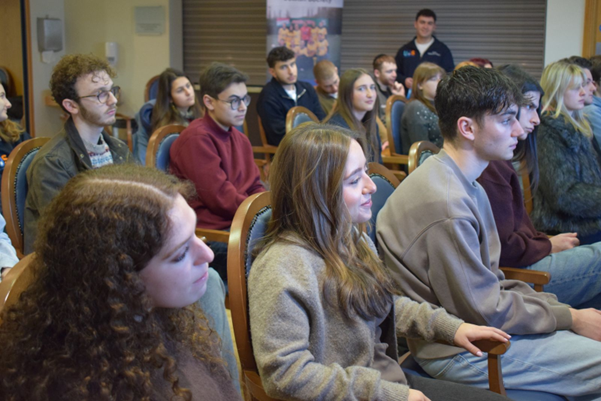
However, I’ve since learnt throughout the fellowship that it is possible to disagree with a peer and learn from each other’s perspectives and the process of disagreeing. In Cyprus, after learning about the conflict between Greek and Turkish Cypriots, it was only natural to draw parallels to the political situation in Israel-Palestine.
This instinctively led to an in-depth conversation about the conflict. After leaving worried that I’d offended those I disagreed with, I was pleasantly surprised to discover that others had felt educated and stretched by what I had to say. On reflection, I felt the same about their perspectives.



Fast-forward to our trip to New York, it’s not every day that you’re able to ask Israel’s International Spokesperson to the UN his thoughts on whether Israel disregards UN opinions and resolutions too often. Similarly, it’s not every day that you’re able to hear the opinion of JStreet’s chair (a US left-wing, Zionist lobby group) when questioned on their lack of support for the Iran war.
I was able to leave both these situations having developed my own political opinions by incorporating different perspectives and lenses that I hadn’t considered. I’d be lying if I said that this process was smooth. Beliefs often carry emotions and hence adjusting them or hearing them challenged isn’t a straightforward process.
Perhaps then, productive discomfort relies on an older value- one embodied in the Kabbalistic value associate with Week 5 of the Omer- humility. To engage in good faith with those with whom we disagree we must cast aside our ego and openly engage with their arguments and logic.
Disagreement, far from being something to avoid, is the key to growth and learning. In a time where campus and the wider community are increasingly polarised, it’s essential to embrace our discomfort and allow it to fuel more and better conversations.
- Asher Friedman is a medical student at the University of Nottingham, a UJS Leadership Fellow 2025-6, and incoming president of Nottingham JSoc.

Keep community journalism free.
Jewish News is free for everyone. No paywall. No barriers. Just trusted journalism for anyone who wants to stay connected to Jewish life in Britain.
If you value that, please support us.
From as little as £5 a month, you can help keep our journalism free and accessible to all.
Every day, we report on the issues that matter to our community. We celebrate achievements, support charities, challenge antisemitism and ensure Jewish voices are heard more widely.
From as little as £5 a month, you can help us continue to:
- Report on the stories shaping Jewish life in the UK and beyond
- Bring our community together through shared stories, events and campaigns
- Celebrate the people, culture and moments that define our community
- Support organisations doing vital work across Jewish Britain
You can make a one-off donation or become a regular supporter. Every contribution helps keep our journalism free, independent and accessible to all.
If everyone who values Jewish News gave a small amount, it would make a real difference to our future.